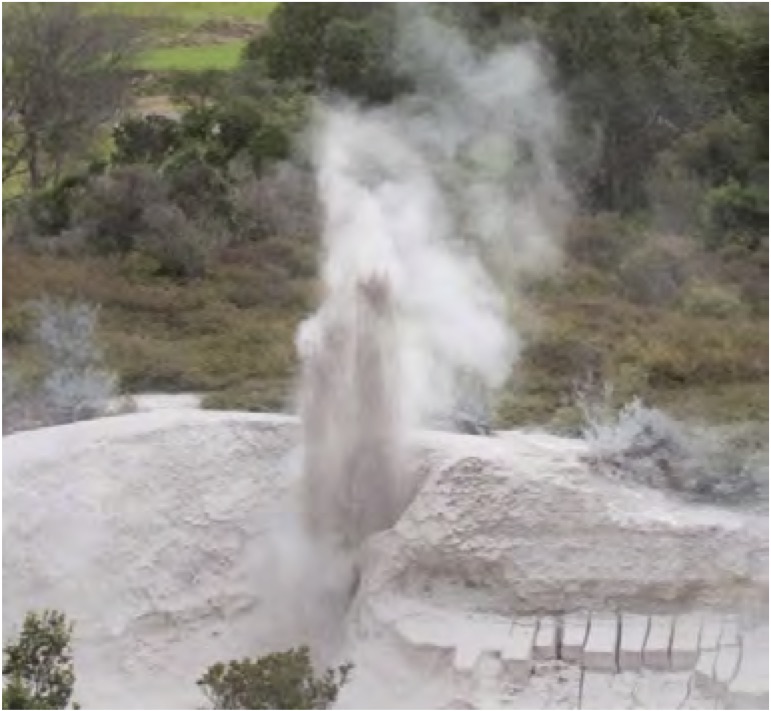
[Update: Added photo of Mud Geyser eruption for reference.]
Today it was a visit to Orakeikorako. We didn't get the earliest start, and due to fogs along the way (especially thermal fogs near Waiotapu and Waikite) the drive was a bit slower than expected. So we arrived a half hour after the opening.
Immediately after we got off the ferry boat we were greeted by an eruption of Sapphire. The intervals varied, with some as short as half an hour, but we managed to catch most of the eruptions during the day. We waited for the next eruption from the overlook, which has a nice view of the entire terrace, and verified that Cascade was huffing and rumbling, but not discharging any water.
After the next Sapphire eruption, it was time to visit the rest of the area. The boardwalk near Manganese and the new collapse features has been rerouted yet again. The new features (what I called #120nw) are mostly filling in with overflow from Manganese and other features at the base of the Golden Fleece Fault. Manganese was still boiling with variable intensity. So it was time to go up to the Artist's Palette.
It was still early and a bit foggy, making it hard to see what features were making all the noise. It was obvious that on the west half of the Palette almost all the features were devoid of water. That included the large Palette Pool, where plantlife could be seen growing on the floor within the crater. Only a couple of vents (like #743) had water in them. Square Pool was steaming, and occasionally the steam would thicken as if there was an eruption down deep in the vent.
On the other size of the Palette there were a number of pools (like #797, #735) that were full and boiling heavily. At the top of the Pyramid of Geysers there was a small sputterer making a lot of noise (it was what could be heard in the fog earlier). At the base of the Pyramid, #812 was full, but not erupting the way it was in earlier visits.
After a half hour or so, I returned to Sapphire. During the wait, I saw what could be called a minor eruption, as it only erupted to about a meter high and lasted about half a minute. Twenty minutes later there was a full eruption like those seen before.
Later in the morning, right after an eruption of Sapphire, I heard noise coming from the plants to the right of Cascade. It was an eruption of Bush Geyser, which consists of splashing down in a vent hidden in, the bush. The eruption lasted just over five minutes.
It was around then that Suzanne saw a new geyser erupt. It was a small vent located on the fault scarp wall just behind The Cauldron at the base of the Golden Fleece Terrace. A check of the map showed this to be feature #123 (with Cauldron #124), and at one time it, or a feature in that vicinity, was called "Prince of Wales Feathers Geyser".
While watching and waiting to see what might happen next, I noticed that Manganese Pool was no longer in overflow. This condition lasted for several minutes, at the end of which Manganese became calm and quiet. When it reactivated, the pool rose and began to overflow again. Later I was able to determine that for the rest of the day, Manganese was having a 15 minute cycle with it not overflowing for about 5 to 7 minutes each cycle.
Back up on the Artist's Palette, I managed to miss eruptions of #760 and #772. #760 continued to have activity down in its vent every 2 to 3 minutes, but I never seemed to be able to record any of this as the wind always seemed to cause the steam to head right toward me, and there were few available viewing options.
Two hours after the first eruption was observed, we all got to see a second eruption. The splashing from the small vent increased in size and vigor and a few moments before the eruption a second vent seemed to join in. The eruption itself was angled to a height we estimated as about 1-1/2 to two meters, and only lasted about 45 seconds.
Based on the interval we'd just seen, we figured there was a chance to see another eruption before the last ferry trip at 17:00. With some time to kill, I went back for another Cascade eruption, and caught the end of a Bush Geyser eruption, too.
As it turned out, this time the geyser #123 erupted with only an hour interval, catching us unaware, but luckily Suzanne was passing by moments before the start. I had decided to walk the mudpot loop, and got a text message about the eruption while I was at the farthest point on that walk. I didn't need to cut the walk short, but got out of there quickly.
We did more calculations, and determined there was a possibility of another eruption just before closing. As it turned out, we reached the hard deadline for leaving with the geyser splashing but nowhere near looking like it was going to erupt.
Finally, on the drive back, we drove the Te Kopia Road so that we could stop in at the Te Kopia Mudpots Reserve. The trail was overgrown the last visit three years ago, so I was pleasantly surprised to find it in not much worse condition. Seems that there are enough visitors there to keep the path beaten down and not completely overgrown.
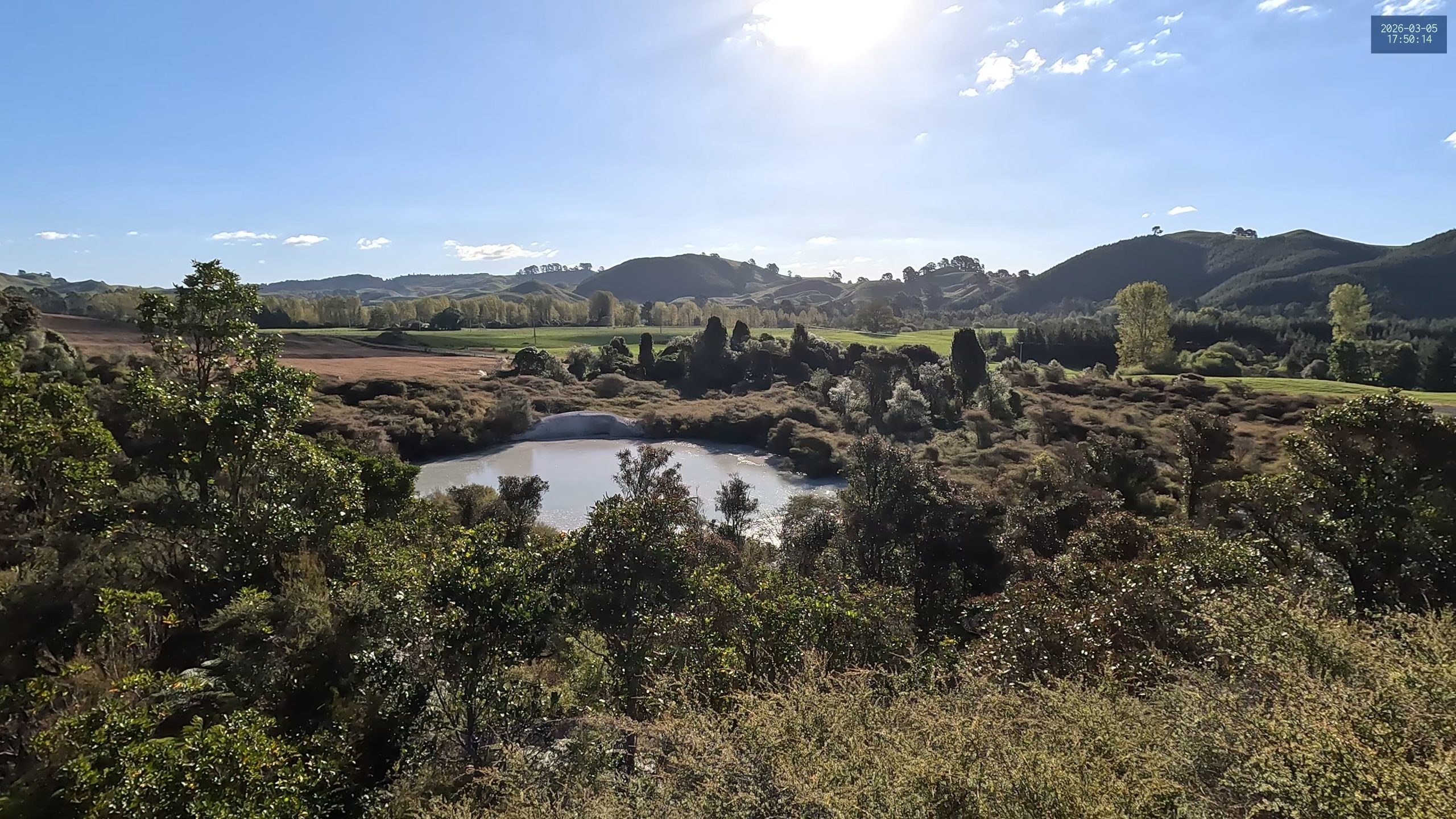
The mudpots looked the same, and this visit I knew were to look for the Mud Geyser. It showed no signs that there had been any recent activity there.
Update: For reference, I'm adding the photo of the Mud Geyser in eruption that was taken in 2009 and can be found at Sinter-forming springs and geysers of the Waikato region [Ashley Cody, Ron Keam, Jesse Lebe, Bridget Lynne, Katherine Luketina
July 2021].