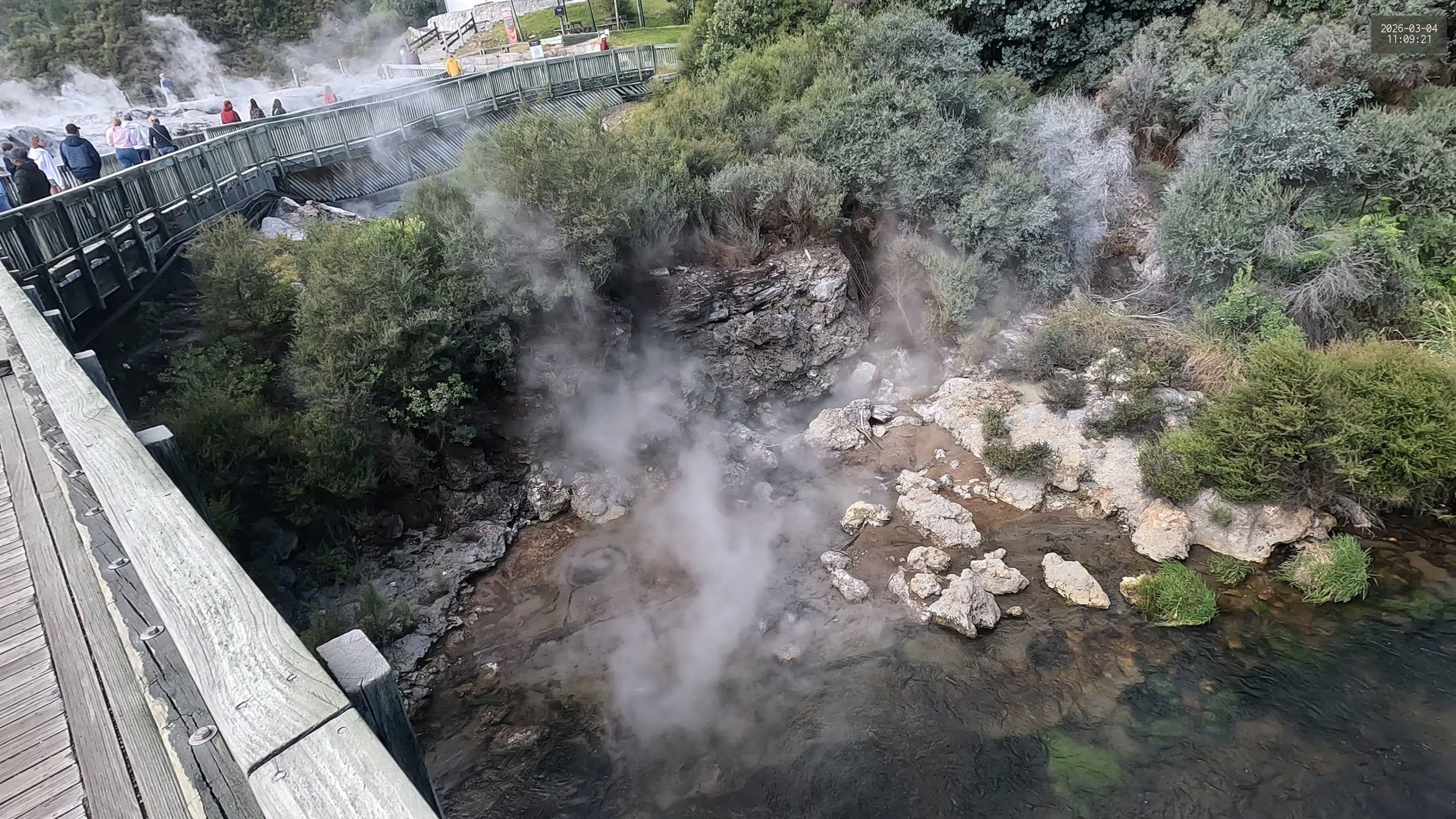
[2026 Mar 22: Updated with photo of new feature location]
Went back to Te Puia today, and the day started out looking pretty good. In the waiting room at the entrance they have a large video screen with a view of the geysers on display as you wait for your start time. While we waited, I noticed nothing that would indicate that Kereru was having minor eruptions. When we finally got out to the geyser area, we quickly confirmed that the geyser appeared to be in the pause mode before a major eruption.
The day was cool, a bit damp, but bright and sunny. The entire day, except for on ten minute period, what little wind there was blowing the steam away from us. But for about ten minutes, the wind shifted and we started to feel some of the spray from an eruption of Pohutu. That's when Kereru suddenly started to look in it was going to erupt.
The eruption was a mass of steam hidden behind the mass of steam generated by the runoff from Pohutu. There was a tour in process, so the bridge viewpoint was noisy, so not only were we unable to see the eruption, we pretty much couldn't see it, either.
That was at 09:44. Until we had to leave at the closing time of 17:30, Kereru had minor eruptions averaging about 2-1/2 minutes apart. Occasionally the interval would lengthen to about five minutes, and we would wonder if we'd just missed an eruption. There were other times that the minor eruption was so strong that we could see the water starting to flow off the terrace, as it does in the major eruption, only for the duration to be normal. So today we learned that the period of minor activity can last up to eight hours, and confirmed that it still appears that major eruptions can't be part of a minor series.
Once Kereru had the major eruption, we knew that it would be a few hours before the next opportunity, as the shortest major series has been about an hour, and the shortest pause around 45 minutes. So I took the time to walk and video the trail running from Geyser Flat to Papakura Geyser. (Pretty much the trail we took last night.) Also took the side trails to Waikite Geyser and Puapua Geyser, both of which are dormant.
At least Pohutu continued to exhibit the expected behavior it showed last night, erupting with intervals of around an hour to 1-1/2 hours. Waikorohihi and Mahanga were also fairly active. I saw several eruptions of Waikorohihi that lasted well over half an hour, and several series of Mahanga eruptions where it would erupt every minite for a few seconds.
It seemed like a fitting ending to our New Zealand geyser visits, where the activity was pretty good, but there always seemed to be a bit of a disappointment (no Waiotapu or Taumatapuhipuhi or Cascade Geyser activity, or just missing Inferno Crater overflow, for example.)
Update: During their visit back in December, Henning and Beatrice Rieske saw a new feature erupting across the bridge from Pohutu. We never saw any activity from this area, and the staining on the plant life was less than I'd have expected if it was still active.