Posted on

Postcard views of New Zealand Geysers


Today was going to be the start of nine days of visiting the thermal areas in and around Rotorua. That didn't happen, but here are a few old postcard views showing things that, for the most part, we wouldn't have seen anyhow.

Te Mimi-a-Homai-o-te-Rangi* Geyser, Orakeikorako

This feature, on the west bank of the Waikato River, now lives beneath the waters of Lake Ohakuri to the north of the ferry crossing over to the terraces. In the 1940s it erupted as frequently as every three hours to heights up to 24 meters (75ft).

Thermal activity near Rotomahana

This card has a postmark from 1905, so it is quite possible that it is showing activity from Waimangu.

Waimangu Geyser, Waimangu Valley.

A view copyrighted 1902.

Inferno Crater, Waimangu Valley

This feature is located about 50 meters to the northeast of where Waimangu was located. It currently has an approximate 38 day cycle of rising to overflow for a few days, then falling. It is also now surrounded by much thicker vegetation.

Wairoa Geyser, Whakarewarewa

This geyser has not been active in decades, but has at least shown signs of recovery since the shutdown of hot water wells in the area.

Wairoa Geyser and other features at Whakarewarewa

One of the features to the right is most likely Pohutu. There are several other features nearby, including Te Horu and Mahanga.

Geysers at Whakarewarewa.

From left to right, it looks like these are Kereru, Mahanga, Pohutu and Wairoa. The view is from the opposite direction of the preceding views, and now what one would first see upon entering through the gate. As with Inferno Crater, there is now a lot more vegetation in the area on the left.

The orifice of the Great Wairakei Geyser, NZ

All of the dozens of geysers in the Geyser Valley at Wairakei were destroyed when the power plants started back in the 1950s and 1960s.


* The name translates to "The urine from [Chief] Homai-te-rangi" [Lloyd, Geology and Hot Springs of Orakeikorako, NZ Bulletin #85, pg.59]. We need more names like this in Yellowstone.


Posted on

Old Postcards and Photos


Plan on doing several posts featuring views of geysers taken from the 1870s to the 1960s. Many of them are taken from postcards.

The first batch features views of large, rare geyser activity from the 1950s and 1960s.

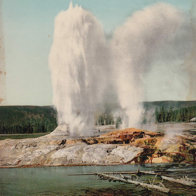
Giant Geyser (Western Photo Sales, Livingston, Mont.) A-105

One of Yellowstone's most spectacular and difficult geysers to catch in play. Erupts at intervals from six to 21 hours for 1 1/2 hours at a time.

A view from the roadway of Giant Geyser, well into an eruption. Most likely from the activity of the early 1950s. Postmark was from 1957.

Giant Geyer, Upper Geyser Basin (Haynes Studios, Bozeman, Mont.) 54K037

Its initial grand bursts, sometimes exceed 200 feet in height, and it erupts for about an hour and a half.

A much nicer photo taken in 1954, based on the ID number. Does not appear to be any activity from the platform vents.

Giant Geyser (Hamilton Stores, YNP) J-1

A spectacular giant located in the Upper Geyser Basin which erupts to height of 200 feet for durations ranging from 45 to 60 minutes. Shown here at the peak of one of her performances.

This is also a giant postcard, triple the area of a normal card. I remember buying it in the early 1980s at the Lower Hamilton's store.

Steamboat Geyser at Norris in YNP (D&G Enterprises, Emblem Wyo.) C-335 Photo by Robert Whitney

Ranks currently as Yellowstone's most powerful geyser. In function, it is a typical cone-type geyser with continuous action. The water phase lasts from 25 to 40 minutes and reaches a height of nearly 400 feet. Rocks are ejected during eruptions from inside the crater.

Surprising to find this. A nice view that is not the standard NPS view. The address of the publisher includes a ZIP code, so this must date from the late 1960s.

Fountain Geyser (Haynes Studios) 51K090

Fountain Geyser in the lower geyser Basin erupts 50 to 75 feet in heightm draining the pool in the foreground with each eruption.

Looks more like Morning Geyser to me. Again, based on the serial number this was taken in 1951.


Posted on

GeyserLog 3.3


GeyserLog 3.3 is now available on the iOS AppStore.

This version of the app includes support for the AppleWatch.

The AppleWatch app is not independent, but relies of the iPhone GeyserLog app to talk with the GeyserTimes server. It is intended to be another viewport into the GeyserLog app.

The app's primary screen allows you to choose four of the more common actions: Stopwatch, Recent Activity, Favorites and GrandWait. Double tapping the displayed time will log an Observation to the paired iPhone app, and display that time for a few seconds.

Stopwatch works in sync with the iPhone GeyserLog stopwatch, allowing you to start, stop and pause, on both devices. If you set the feature name on the phone, it will be displayed on the watch.

Recent Activity shows the latest dozen events posted to GeyserTimes. No notes, though.

Favorites shows the latest activity of those features that are shown in the iPhone GeyserLog's Favorites view.

GrandWait allows you to record events and activity without the need for using your iPhone screen in adverse conditions.

There's also a watch-face complication which will take you directly to the watch app, while saving the current time as an Observation. Double tapping on the clock in the primary screen will also save an Observation time, and show it for a few seconds.


Posted on

More rare eruption photos


Round Geyser, 1989

A view of Round Geyser in eruption as seen from Geyser Hill, near Depression Geyser. I don't know who took this photo, or remember how I got a copy.

Next are three photos Mary Ann Moss took. Opal was a geyser that she saw several times over the years.

Opal Pool, 1979 Sept 13. Photo by M.A.Moss
Cauliflower Geyser, 1983 Sept 22. Photo by M.A.Moss.
Excelsior Geyser, 1983 Sept 15. Photo by M.A.Moss.

This eruption doesn't look all that big, but note the figure standing on the far overlook at the left. Also, the jet from the big boil is easily well above the rim.


Posted on

GeyserLog 3.2


GeyserLog 3.2 is now available on the iOS AppStore.

Lots of changes in this release:

On launch, get the latest eruption for every feature. Also, on upgrade or install, get every eruption for Giant, Giantess, New Crater/Steamboat, and Fan & Mortar since 2017.

Added the option of getting the history for any feature. One month, three months, six months, a year, and since 2017.

Tapping on the location of a feature in the Feature view header will open the Maps app, dropping a pin and focusing in on that location.

Export of GrandWait summary and DetailRecord to a text file accessible through the Files app.

Hiding of notes, comments, and secondary eruptions, allowing the reducing of clutter in longer lists.

Added Recent Users. Can select observer names from list of registered users when submiting an eruption. A list of the most recently used names is kept for reuse.

Added Observations. Many pages now contain a button in the title bar which will save the current time as an Observation. Opening the Observation view shows a list of these, where one can be selected and used to create a eruption or note submission. If so used, the Observation is marked as used. (Although it can be reused.) Observations are also used in the creation of Details (see next section.)

Added Details. Allow the capture of minor non-eruption events at a feature (for example, events with Fan & Mortar vents, or during a Giant Hot Period). Uses Observations to capture time. Each feature keeps a list of the subjects as they are added (for example, Fan vents) for reuse. Second list are the basic event comments. A summary of the details can be made and added as a comment to a GeyserTimes submission, or saved to a text file or the clipboard.

Background updates should work better. Other UI cleanup, crash fixes, and bug fixes.


Posted on

Link Geyser, 1983


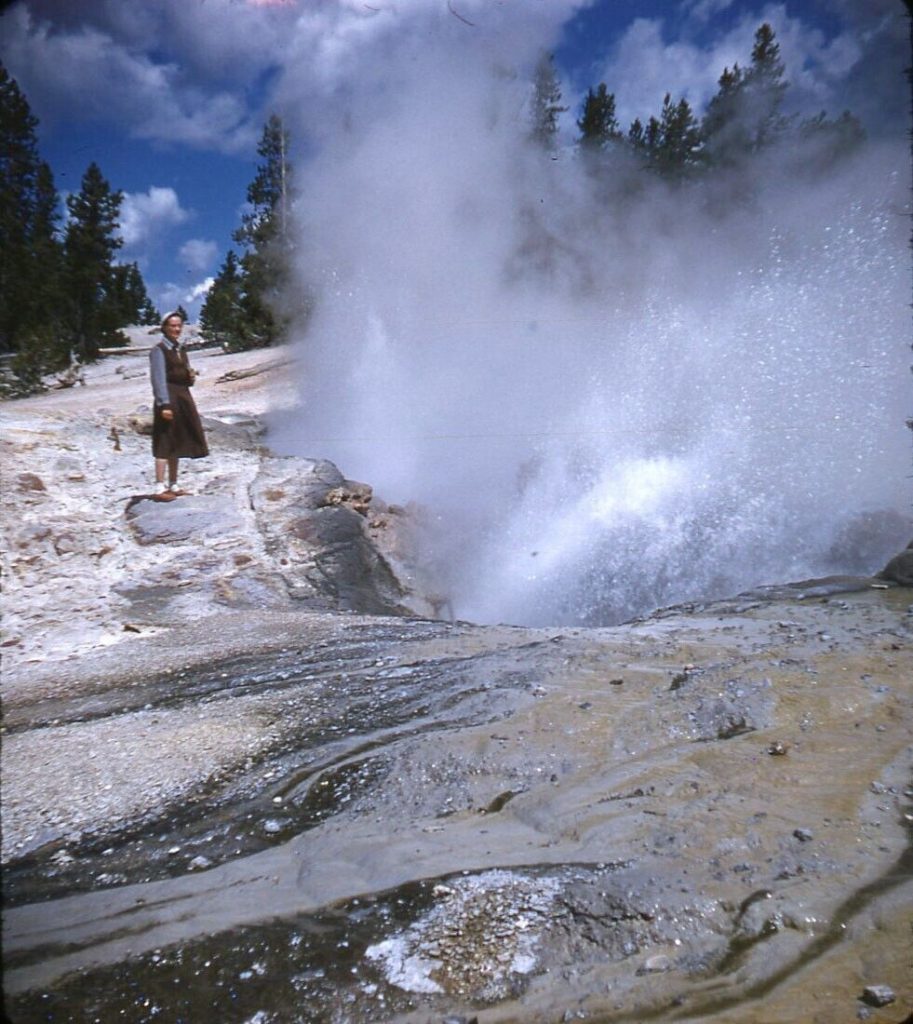
Here's a series of photos showing some of the activity of Link Geyser and the Chain Lakes Group during the activity in October 1983. Over a period of five days, Mary Ann Moss, Marie Wolf and I got to see several dozen major eruptions. We missed much of the activity of the first day.

Mary Ann took these photos, and as you can see, it was cold, damp and gray that week, which made seeing the eruptions difficult at times, but it didn't snow or rain. For more details on the activity, see my article in one of the early GOSA Transactions. Think of this as a supplement to that article.

Runoff from Link Geyser eruption in Oct 1983. Photos by M.A.Moss.

Here's what we saw of one of the first eruptions we witnessed. A lot of steam coming from opaque water. The ruts produced by the runoff channel didn't get much deeper or wider over the next few days, which supports our conclusion that the first few eruptions that no one saw were even more voluminous and powerful than what we saw.

Link Geyser eruption, October 1983. Photo by M.A.Moss.

Here's one of the better photos, showing some of the details of the jets. I would estimate the height here at around 15 meters. We think we saw higher, more angled jets at times.

Link Geyser runoff, Oct. 1983. Photos by M.A.Moss.

A couple more views of the discharge from an eruption.


Next are a series of close-up views of the drained vents of the Chained Lakes.

Clasp Geyser vent, Oct. 1983. Photo by M.A.Moss.
North Chain Lake Geyser vent, Oct. 1983. Photo by M.A.Moss.
Vent between North and Middle Chain Lake Geysers, Oct. 1983. Photo by M.A.Moss.
Middle Chain Lake Geyser vent, Oct. 1983. Photo by M.A.Moss.
Bottomless Pit vent, Oct, 1983. Photo by M.A.Moss.
Link Geyser vent, Oct. 1983. Photo by M.A.Moss

Eruption of Link Geyser, Oct. 1983. Photo by M.A.Moss.

Firehole River just after eruption of Link Geyser, Oct. 1983. Photo by M.A.Moss.
Aftermath of eruption of Link Geyser, Oct. 1983. Photo by M.A.Moss.

Note the debris washed onto the bike trail. We never saw an eruption put out enough water to reach that far, which again supports our assumption that the first eruptions were even larger.

And that's J.Randolph Railey watching the eruption.


Posted on

Grand's North Triplet Sputs


It appears that the locations and designations of the various sputs that have appeared in and around the old site of North Triplet are in need of further documentation. In going through some old files, I came across photos that Lynn Stephens took of that area in October 1989. While a lot of things there have changed since then, this does give a good record of what was happening there, and how it relates to current activity.

Sketch map of Grand's Sputs area. From 1989.

The map comes from my original GOSA Transactions article on the area, and is still a good guide. The only major difference is the disappearance of East Triplet, and the associated Sput-Cs near it.


Sputs overview, Oct 1989. Photo by L.Stephens.

In the center of this photo, with a downed branch beside it, is Sputnik, or Sput-B. To the left, the plume of steam, is Delta, or Sput-D. In the foreground are several frying pans constituting Sput-E, which are no longer active, but the area is still devoid of vegetation.


Sputs-F, Sputnik and East Triplet. Photo by L.Stephens.

On the left edge of the photo the rim of East Triplet's vent can be made out. Above and to the right, beside the downed log is Sputnik. The large brown area of dead grass is Sput-F. Eventually, three areas of activity became more pronounced and were given sub-designations.

Sput-F. Photo by L.Stephens.
Sput-F3. Photo by L.Stephens.
Sput-F1 and Sput-F2. Photo by L.Stephens.

Sput-B1. Photo by L.Stephens.
Sputnik (Sput-B), 1989 Sep 17. Photo by L.Stephens.

Sputnik also developed some satellite vents, one on each side. Over the years the craters have been filled and cleared out, so which is which is probably not possible to determine any more.


Sput-E1 and Sput-B2. Photo by L.Stephens.

In the foreground is the wet frying pan at the north end of Sput-E. Behind it, in the middle of the photo is Sput-B2, while Sputnik itself is near the top of the photo.

Note that at this time, Sput-D was a small hole which steamed heavily. Over the years it enlarged itself.


Grand Sputs in 2020. Photo by H.Koenig

The photo I took last year isn't from up close, but one can still see the are of Sput-F is still active, and the grass there hasn't recovered. Finally, here is a short video showing the area with everything that was active in June 2020.

Grand Sputs, 2020 Jun 25. Video by H.Koenig