After yesterday evening, I had no desire to go out for the cloudly, wet, moonless eruption of Grand during the night. Instead slept in a bit and then went out to the Bijou Cage to see what might be going on.
It was still gray and overcast, but the rains had quit and weren't supposed to be around for a few hours. Down in the Cage we were getting events every hour or so. What I saw were the minimum, with just Bijou pausing and water just visible in Mastiff, but later there were some with Southwest Vents activity and water visible in Feather. But what I did see were Bijou pauses that lasted well over four minutes, with the water in Mastiff only becoming visible midway through the pause.
After several hours, the weather got nicer, with some actual breaks in the clouds and sun warming things up. Transfered my attentions down to Grand, where once again it was over two hours of Turban intervals that slowly got shorter, down to about 16 minutes.
Then West Triplet started, and the One Burst Grand eruption started on the first opportunity ten minutes later. This eruption was notable in that there was a relatively long False Pause, a little over eight minutes into the eruption, that lasted about three seconds, long enough to note the end of the time. It felt like the pool was quiet, but a review of the video shows several boop-like boils during that short period.
Afterwards, the pouring rain waited until I was inside the cabin.
Waited several hours for the rain showers to stop, then headed back out to the Bijou Cage. Oblong started to erupt just as I rode past. Over at the cage, nothing much happened while I was there, then it was time to head back to Grand.
Walking through the Sawmill Group, I noticed that Churn was almost at overflow. Slurp was liquid with the usual steamy noise. Belgian Pool was high, with the side lobe full and a bit murky. In the past it seems that murkiness happens after heavy rains.
It was then I realized that I was an hour earlier than I needed to be. Instead of leaving, I just waited things out. As it was, the next Turban eruption became a Turban Delay Interval. After four more Turban eruptions, West Triplet finally started.
The One Burst Eruption took place on the second Turban eruption after West Triplet had started. As I had expected earlier, this eruption took place in that gap between sunset and moonrise, so it was pretty dark.
Afterwards I went back to the Bijou Cage for a while, as there hadn't been any Bijou pauses or Mastiff bathtubs for several hours. By then the moon was well above the ridge, and the clouds had cleared away. Two hours later I left with no change in the activity.
It rained during the night, but at dawn it was just gray and damp. I arrived at the Grand Group to see that West Triplet and its runoff channel were empty but steaming. So ended up waiting in the rain for the next West Triplet eruption. It only started to sprinkle near the end of the wait for another One Burst Eruption from Grand. Another eruption just long enough, while too long for a first burst, it appears.
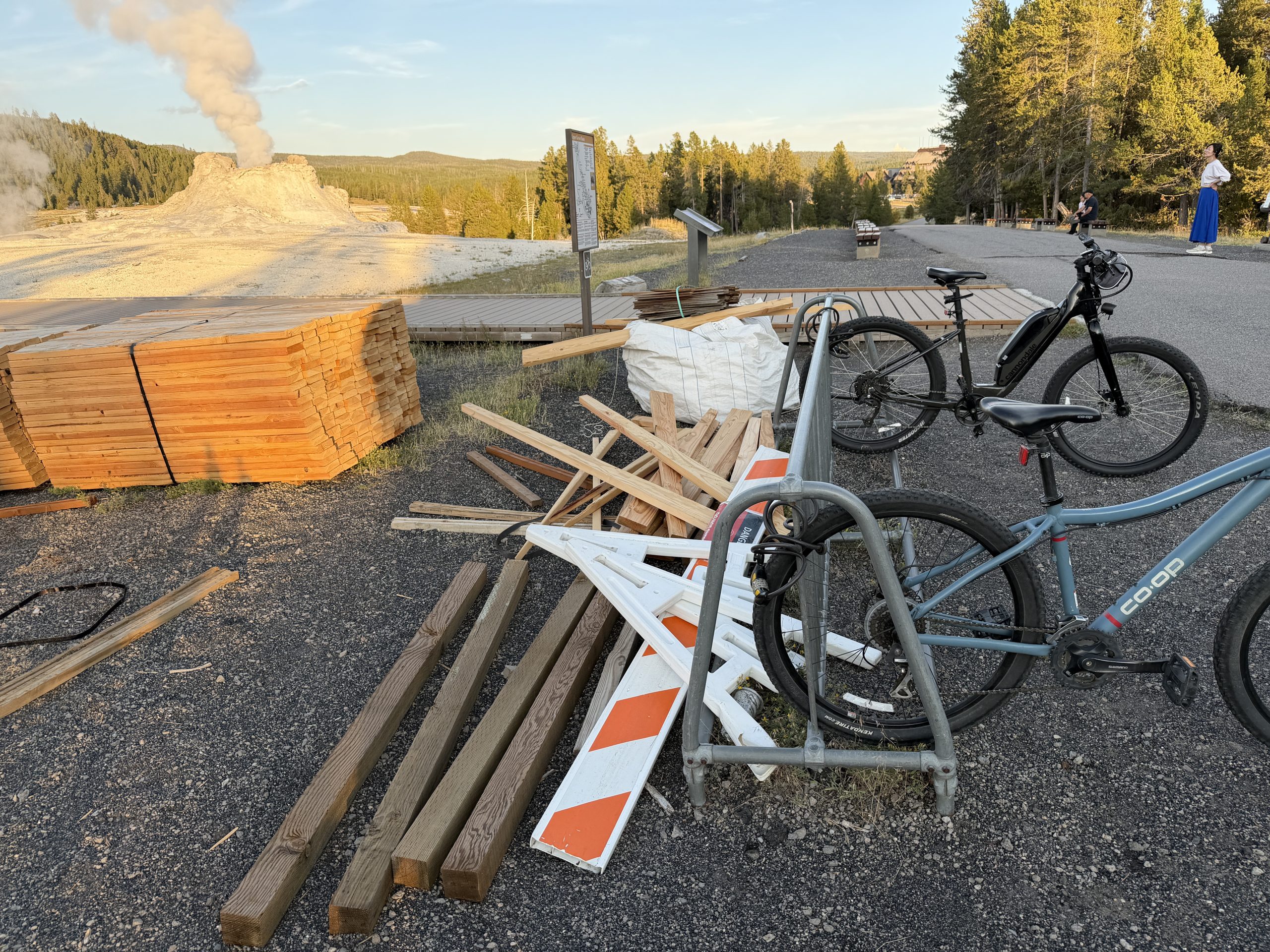
The Boardwalk Crew had arrived and were setting up by Castle. I overheard them say they were closing the boardwalk around the Sawmill junction. I did ask if the walkway would be open, and was told they'd be done around 15:00.
It does seem that too often at the start of Grand's eruption there can be light or no rain, but by the time I get back to the cabin, it's pouring and I'm soaked.
The rains had mostly ended by the next time to head out to Grand. The Boardwalk Crew removed their barricades just after 15:00. It was a bit early but I wanted to beat the shower that the weather map showed was headed our way. As it turned out, it never got here.
That began a four hour wait of a long series of Turban eruptions where the intervals slowly got shorter until West Triplet erupted. During that time we got to see another eruption of Oblong, as well as another Castle major eruption. When Turban erupted after the end of the West Triplet eruption and Grand didn't erupt, I knew that we had well over an hour of waiting ahead of us.
Finally we got a good, early fill and Grand started right after Turban with several tall spikes in the starting activity. When the first burst ended at about 9-1/2 minutes, I expected that to be the eruption. Instead, a quick 20 seconds later we got another burst. This one wasn't as tall and came within two seconds of being a Long Second Burst.
I do wonder why there are three webcam reports of Beehive erupting this morning when there was already a report from an observer in the basin. Gotta get those geyser gamer points any way you can, I guess.
Once again, headed out to Grand at dawn. Did see post-eruption steaming in Uncertain as I went past. I had to wait 18 minutes from my arrival to see the first Turban eruption, and based on the lack of overflow on the next Turban eruption, I would say I got to see a Turban Delay Interval.
A half hour later, Castle could be heard erupting. It was clear when I crossed over, but by then it was foggy enough that only the top of Castle's steam column was visible. It was a major eruption, and the sound of the steam was loud since there wasn't any background noise from the road and all the other activities of the day.
Grand finally erupted on the fifth Turban eruption after the Delay, and it was a steamy, but backlit One Burst Eruption. West Triplet started midway through the eruption.
Then it was down to the Bijou Cage. Other than Bijou erupting away, nothing happened there for an hour. Then we got a strong Mastiff surge. Within a minute water was visible in Mastiff. Bjiou did not shut down, and barely slowed down. There was some spitting from the Southwest Vents, and thanks to the sun angle, water could easily be briefly seen in Feather. After Mastiff dropped, Catfish and the B-C Vent splashed briefly, and Bijou began roaring.
On the way back from the Cage, I was leisurely riding my bike down from Castle when Tara Cross came racing past me on her bike. I realized that I had turned off my radio during the bathtub event, and looking over at Geyser Hill, could see the steam from the Indicator. I picked up speed and followed her and was able to get to Geyser Hill in plenty of time to see the Beehive eruption. Once again, the little opening at the bottom of Beehive's cone was spitting water about 10-15cm from the cone during the time when Beehive's Indicator was erupting.
I went back out to Grand in the afternoon. Over a 2-1/2 hour period, I got to see nine eruptions of Turban where the intervals and durations got progressively shorter. After a 15-1/2 minute interval, there was a longer twenty minute duration, where Grand looked like it could erupt-- the pool was full and having small waves. But it dropped as Turban started. Twenty minutes later, West Triplet finally started erupting, and Grand took the next opportunity to also erupt.
The One Burst Eruption lasted well under ten minutes, but once the burst ended, Grand refilled, and for almost 1-1/2 minutes, water sloshed around the pool as if we might get a second burst. Then Grand drained, and Vent & Turban also quit.
Forty-five minutes after the start of the West Triplet eruption, Rift also began erupting.
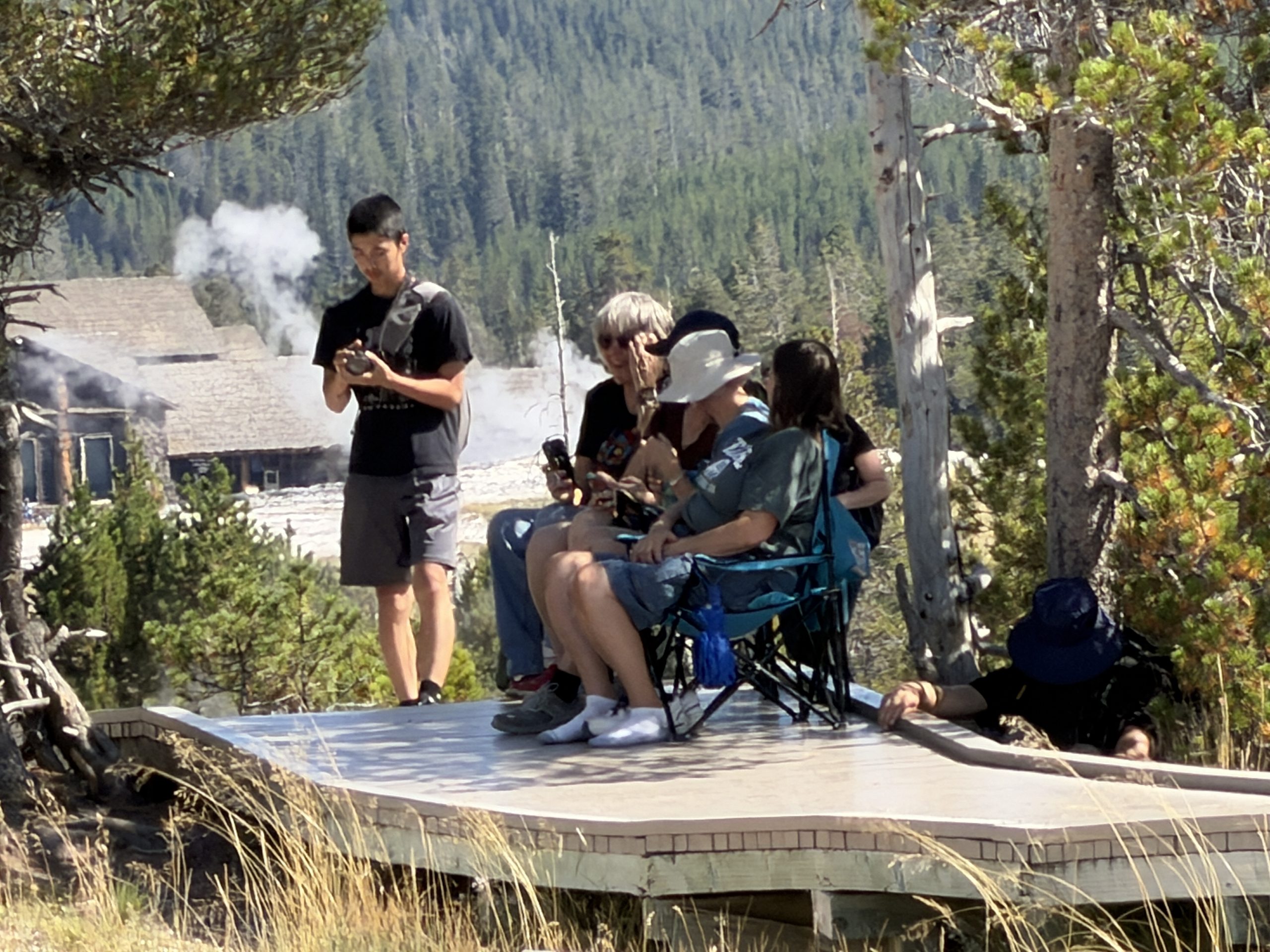
The little bit of shade where the walkway narrows in front of Rift always attracts people who clog up the walkway. Today they brought folding chairs (and also were off trail in the trees) and forced everyone as tall as I am to have to duck under the branches of the tree.
Boardwalk blockers at Rift
The partial lunar eclipse was a bust. At first there were clouds with lightning to the southeast, blocking the view. Then it rained.
When I headed out to Grand, the eclipse had passed the mid-point. The clouds were thinning out, so it was hard to tell that the moon wasn't completely full. Out at Grand, it appeared that Turban was about to have a Delay Interval, when instead Turban started to erupt. The steam from Grand's pool didn't look like it was building to an eruption, so it was a pleasant surprise when it started.
As with the afternoon eruption, the duration was less than ten minutes, and after a bit of a delay, Vent & Turban quit. I suspect that during those two minutes Grand was attempting to have a second burst, and failed.
As we left, realized it had been 17 hours since Castle erupted. So waited a while, but Castle wasn't even sloshing. I decided to head in, and before I could put on my pack, the eruption started. For the first few minutes, Castle acted as if it was going to have a minor eruption, but after the seven minute mark, there was little doubt that it would be a major eruption.
By this time, the clouds were all gone and the eclipse over. There was also a moonbow visible low in the steam and spray wetting down the boardwalk.
Got up before dawn and headed out to Grand at the 7-1/2 mark. Arrived there and the pool was full. Castle had a major eruption that started around that same time.
The wait for Grand was nearly 2-1/2 hours, a series of unremarkable Turban eruptions, although during that time we did get to see an eruption of Oblong. The One Burst Grand eruption was long, nearly 12-1/2 minutes long.
While waiting, we had two bison appear down by Beauty Pool and slowly head our way. One went in back of Turban and Grand in the steam, while the other headed directly for the benches. As expected, it just passed by, and both disappeared up the hillside behind Rift. (I wanted to post a picture, but it was so close that the camera only captured its top half.)
Had originally intended to head down the Giant after Grand, but the wait was so long we decided to head in and reconfigure first. Then it was down to the Bijou Cage.
In the two hour wait, at first there were a couple of small Mastiff far vent surges, then nothing happened for over an hour. We finally got a large surge, followed by water in Mastiff, but Bijou didn't even slow down much. When Mastiff refilled, Catfish and the B-C vent erupted for a few seconds, the Bijou began roaring for about 1/2 minute.
After lunch in the cabin, returned to the Cage for an hour, where I got to see the Oblong eruption, the fourth in two days.
From there, it was back to the Grand Group, where Turban had a long series of eruptions. West Triplet started about 45 minutes after arrival, the another 45 minutes later, Rift started. That eruption lasted about 40 minutes, and then we had the One Burst Eruption on the next opportunity.
The day before the full moon, so it was bright out, along with partly cloudy. Walked up to West Triplet in eruption, and had just enough time to settle in when Turban had one of its explosive starts, followed by Grand.
A strong breeze kicked up, pushing the steam out so that there really wasn't a good place on any part of the boardwalk to see the One Burst Grand for much of the time. And having the moon disappear behind a cloud didn't help. But was nice that we had no wait.
It was dawn and I was walking down from Crested Pool when I saw what appeared to be an eagle flying low upstream along the Firehole River. When I got to the bridge, that's when Grand began to erupt.
Took a little longer to get over there, because the boardwalk between Sawmill and Belgian is in the hands of the trail crew. But arrived in plenty of time to catch the end of the first burst, which lasted just under nine minutes. After a fairly normal pause, I got well over two more minutes of activity.
Since I was already up and around and prepared to be out for a while, there was no reason to head back in. Instead I went down to the Bijou Cage. The Giant platform looked like nothing much had happened recently. The area around the Southwest Vents was dry, and the small puddles in front of Giant looked like they came from its activity. There was a bit of water in the far runoff coming from Mastiff, but it was a cool, damp night.
Was there for nearly two hours, and saw a few small Mastiff surges, but the last one was almost an hour before I left. At that point, I went in for breakfast, and returned to the cage about an hour later.
This time I had barely settled in when Mastiff had a huge surge to at least two meters that lasted 45 seconds. Sometimes Bijou pauses after these surges, so I kept watching, and while Bijou did not stop, water became visible in Mastiff.
Water was not high, maybe down 30cm, and was only visible for less than 1-1/2 minutes. I saw one spit from the Southwest Vents. By the end, Bijou, which had never stopped, was erupting even stronger. It then began roaring with Catfish active.
Left the cage and the basin for a while, and about 1/2 hour later, Oblong erupted for the first time in several months. Returned to the cage briefly, just to confirm that nothing major had happened at Giant during Oblong's eruption.
Then headed over to Grand just in time for the Turban Delay Interval eruption. Was pleasantly surprised that we only had to wait four Turban eruption intervals before the One Burst Grand. The eruption started in shadow, but the cloud moved away by the start of Vent. Shortly after that, West Triplet also erupted.
As we left Grand, we got to see the second Oblong eruption of the day. Thanks to the trail construction, we didn't try to backtrack to see it from the Grand benches.
From there, it was back to the Bijou Cage again. A half hour after my arrival, I got another large Mastiff surge (ten minutes after the previous, smaller surge). Two minutes later Bijou was off. Water never rose very high in Mastiff, and again there was only a splash or two from the Southwest Vents. The pause lasted 3-1/2 minutes, and once again, when Bijou started, it began to roar. Catfish and the C-B Vent also showed some activity at that time.
Went back out again in the late evening, after getting some overhead done back in the cabin and after waiting for a shower to pass. Waited almost an hour before finally got a large Mastiff surge that led to a Bijou pause. It was similar to all the previous pauses, with Mastiff showing visible water and a couple of Southwest Vent splashes. The pause lasted almost four minutes, and then began roaring after the restart. Grotto was erupting as I left, but I didn't notice the start.
West Triplet was in eruption as we arrived for the evening moonlight Grand eruption. Shortly after West Triplet ended Percolator also paused for about 1-1/2 minutes. It was disconcerting for there to be silence out there.
There was little runoff prior to the Grand eruption start. The start itself was sudden and explosive. By a nearly full moon, the second burst seemed to be tall and thin.
Based on the recent short intervals, headed back out to Grand before the seven hour mark, while it was still dark. Ended up waiting six Turban eruption intervals. For most of the wait the breeze was non-existent, but during the eruption the benches on the north end got soaked, and I'm sure there's not much to see on the video
Afterwards, decided another wait in the Bijou Monkey Cage was in order. One bit of Guru Geyser Gazing I've noticed is that the events of the last few days have come on six hour (or multiple of six hour) intervals. The meant that we had a chance for something to happen around noon.
After a two hour wait with only small Mastiff far vent surges every 10 or 20 minutes or so, we got a large surge. Bijou was already completely off at that point. Shortly after, water was visible rising in Mastiff. At first there were a few spits from the Southwest Vents, and some splashes from Catfish. A minute later the Southwest Vents were putting out a couple of streams of runoff. We also noticed that water appeared to be pooling in Feather, but it was hard to be certain.
Bijou came back on after a pause of at least 4m17s. Catfish also had some tall surges, and the "C-B Vent" erupted briefly to about 20cm.
Before the event started, there were a group of four men talking at the other end of the platform, and it sounded like they had some knowledge of geysers and the Giant area. Just before the event started, it looked like they had started an on camera interview. So in the background of their video they have Suzanne and I suddenly climbing the bench and staring at the platform, with Suzanne making announcements over the radio for the duration.
They may have been doing a video for the YVO or some such. In any case, I'd definitely be interested in hearing if anyone sees such a video.
During that wait, I also heard a woman in a family group ask, "Which one's Giant?"
Got back to the cabin (after a forced NPS bison babysitting detour) and shortly after got the Beehive radio call. During the eruption I noticed a small vent squirting water out to the north from a hole about 15cm above the platform to a distance of about 1/4 meter. It quit with Beehive's Indicator. It was windy, so the eruption of Beehive got the usual stretch of boardwalk wet.
West Triplet started erupting just as I tied my bike down at Castle. With no following eruption of Rift, I expected a wait of a few hours until the next West Triplet eruption window. Two and a half hours later, Grand filled nicely, followed by almost 15 seconds of boops before the One Burst Eruption started. Midway through that, West Triplet started erupting.
Since it was nearly six hours since we saw the Mastiff bathtub hot period, we went down to the Bijou Cage to wait and see if the six hour intervals would hold. Ten minutes after arriving, we got a huge surge from Mastiff, which lead off a shorter and weaker bathtub. While the water level in Mastiff seemed the same, there wasn't any Southwest Vents activity other than a few spits, and the Bijou pause was shorter. The next two opportunities are going to be in the dark, and we won't be attending.
Since the thunderstorms last night kept me from going out and seeing Grand, I went out at dawn not knowing what to expect. (Dawn is now after 06:00 and getting later every day.)
It was cloudy with fog down below. I got out to find Grand in heavy overflow that ended almost immediately, followed by Turban erupting. The next Turban interval had no overflow, and the next was a long Delay Interval.
After that, it was an uneventful wait until Grand filled nicely for the fourth Turban eruption. The One Burst Grand was a steamy mess, with a wind blowing steam and spray all over the northern benches.
Next it was down to the Bijou Monkey Cage. Over the a period of over two hours we saw a few Mastiff surges, but Bijou never paused. then there was a surge that, unlike the previous surges, started slowly instead of suddenly. That built into a the largest surge of the morning, and about then Bijou slowed and paused.
The pause lasted 3m09s. The water in Mastiff was at about the same level as yesterday. There were a couple of spits from the Southwest Vents, but no large surging in Giant.
I got the Beehive Indicator call in the cabin, and made it to the railing for the start of Beehive's eruption. It was windy, and no way I was going to proceed further.
An hour later it was time to return to Grand. West Triplet was in eruption as I tied down my bike. We only had to wait one Turban eruption interval, and the Grand start was a bit of a surprise. It also took Vent about 4-1/2 minutes to start. West Triplet ended early in the Grand eruption.
With the short wait, it was on to the Bijou Cage. After about a two hour wait with a few small Mastiff surges, we finally got a Bijou pause. This was similar to the activity we'd seen this morning, except this time the Southwest Vents were active during the last minute, putting out enough water to form pools on both the platform and the shelf below.
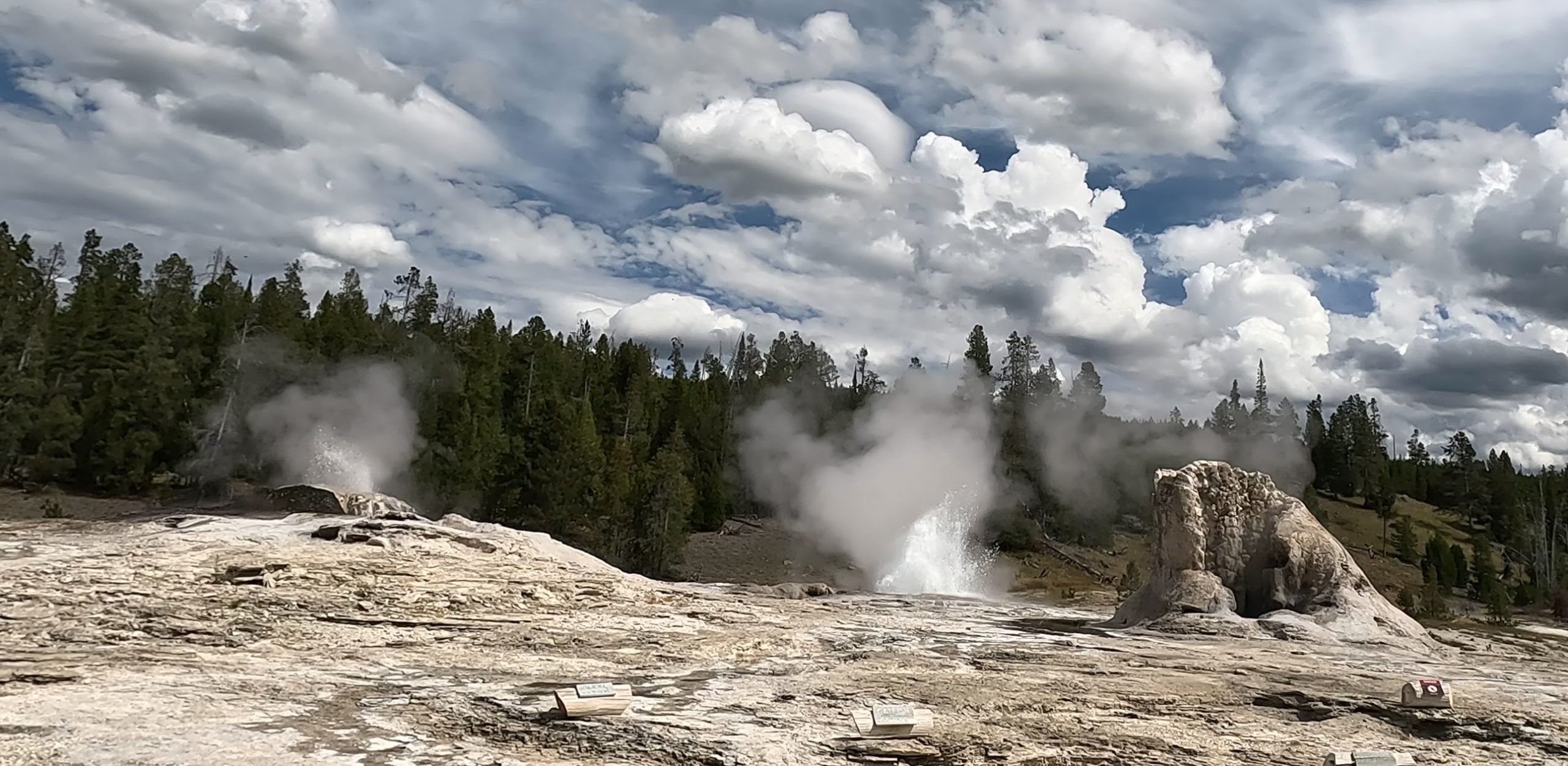
Overflow from Southwest Vents during Mastiff bathtub. 2026 Aug 23 18:06
Finally went out for a nighttime Grand. It was mostly clear, and the gibbous moon was bright enough. Had to wait just over an hour, with no Turban Delay intervals, and finally got to see a two burst eruption. In the middle of the first burst, the moon disappeared behind a cloud, so the second burst was just barely visible. The total eruption lasted less than ten minutes, and then Vent & Turban quit.
As expected, Grand was below overflow, and I estimated that the eruption had happened about three hours earlier. So plenty of time to go down to Giant and see what happened.
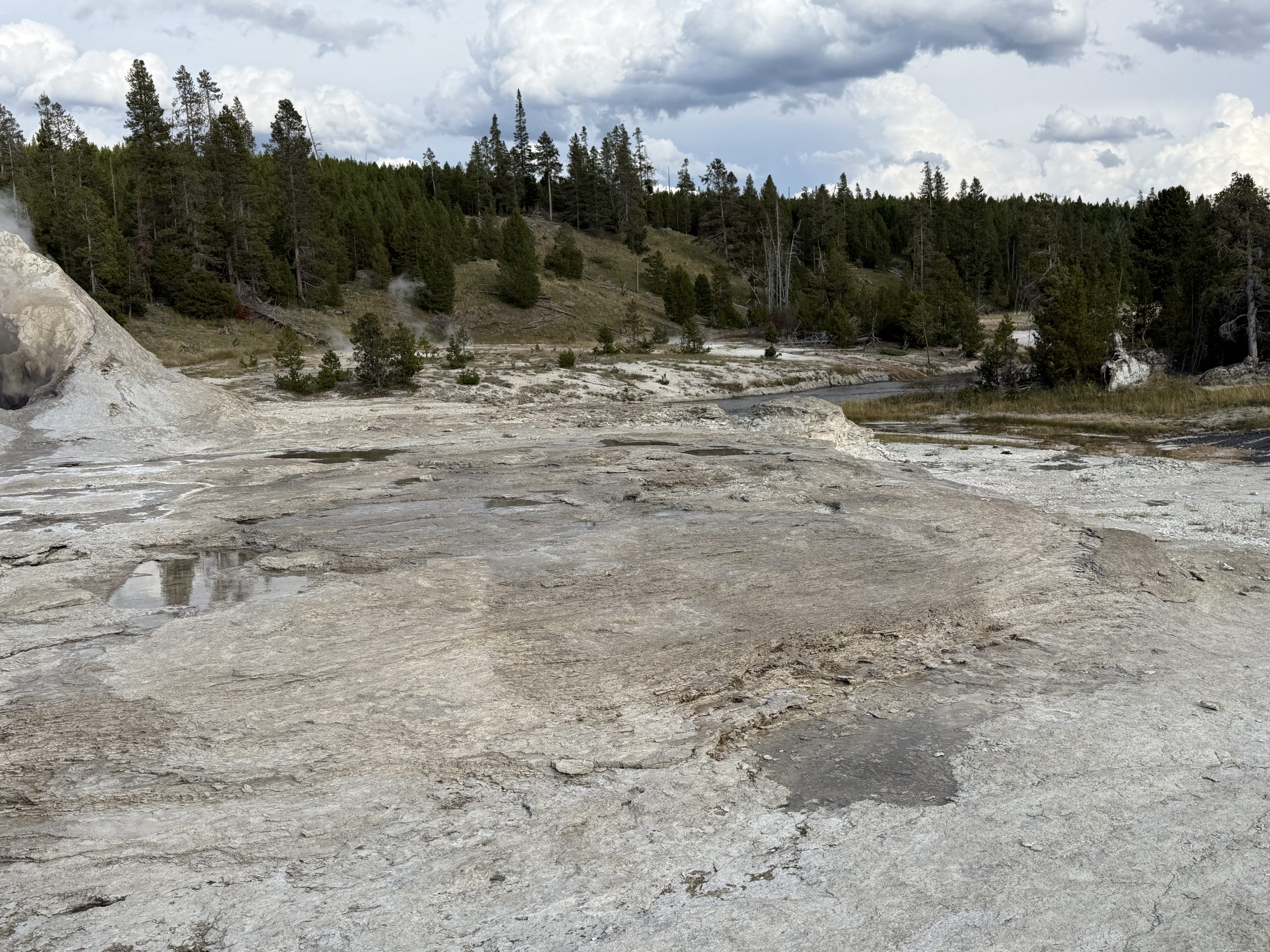
I arrived there and Bijou was on strong, with no evidence of any recent platform activity. Across the river the steam rising from the Purple Pools runoff channel was obvious.
Every so often Mastiff would have a strong surge with thick jetting to the south, refreshing the shallow puddle between it and the base of Giant's cone. In a couple of cases, these surges preceded a Bijou pause or slowdown.
After 2-1/2 hours, I left to go and get ready for the next Grand eruption. Instead as I arrived at the cabin, I heard the radio call for the One Burst Eruption.
So I went back out to Giant. I was gone for about 50 minutes. As I arrived, I noticed that the Giant Indicator Pool (GIP) was high, about 30cm below the rim. Normally I can't see the water level. I was told that Bijou had not pause while I was gone, so it had been active for about two hours.
Mastiff continued to have some surges, some fairly large. Giant was also having surges that reached above the top of the bite in on the right side of the cone. These large surges would put water out the front of Giant, refreshing the puddle there.
Catfish was mostly quiet, but once I did see some splashing from it for a few seconds.
Finally, over six hours since the last pause, Rocket had a major eruption about 2-1/2 hours into a Grotto eruption. Then there was perhaps the largest Mastiff surge seen yet, and shortly after, Bijou quickly got quiet. Forty five seconds later water was visible in Mastiff. It never got higher than 30cm below the rim. The Southwest Vents did splash for a few seconds, and Giant had one large surge to the top of the cone. After 3-1/2 minutes, Bijou restarted.
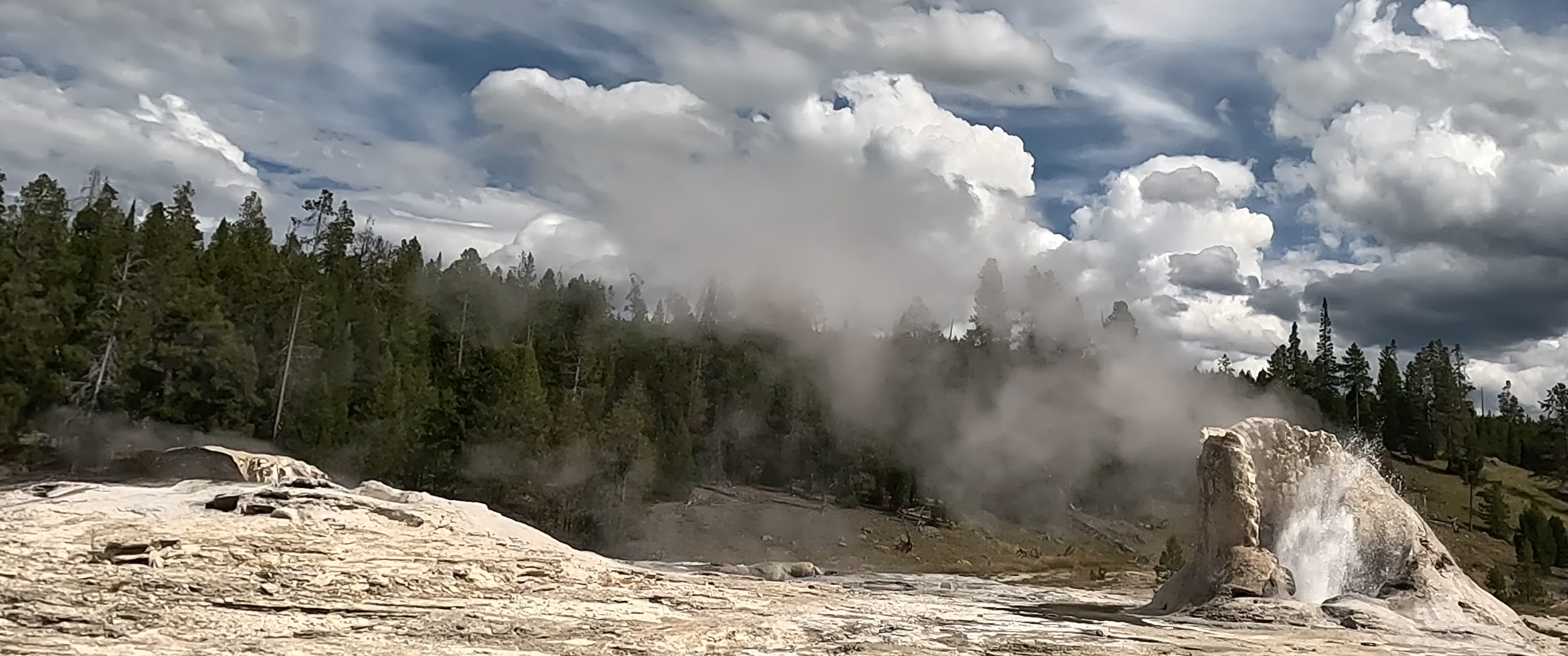
Mastiff surge prior to Mastiff bathtub, 2026 Aug 22 14:45
Giant surge during Mastiff bathtub, 2026 Aug 22 14:45
Grotto finished erupting shortly after, for a duration of just under three hours. Water was not visible in the GIP.
Once again returned to the cabin to get ready for Grand. Because of the previous short interval, I decided to get out early. As it was, I saw Rift erupting when I arrived at the bike rack, but it had finished by the time I got over there. Turban started erupting as I sat down on the bench, and as I pulled my camera tripod out of the pack, Grand followed with another One Burst Eruption, one lasting 9m21s.
While I was out in the Bijou Monkey Cage, a geyser gamer reported an eruption of Daisy over the radio. I look over and see no steam, so figure either he's wrong, or he was reporting the very end of an eruption. I wait and look over frequently, and ten minutes later, I see Daisy start. So I make a post for the real eruption, then flag the erroneous report. First that report gets change to have the proper near start time. Then it gets deleted, along with my flag, and a new, superfluous secondary posting with a near star time appears. Why this person felt the need to duplicate my posting after screwing up, I don't know.
The radio call for a Penta major eruption went out just as we were about to head out into the basin. There was no report on Grand, and it had been only 14 hours since the previous observation. We also had to vacate our cabin so we could transfer later in the day to the one we prefer.
Got out to Penta and it was definitely in a major eruption. The start, however, was different from years ago in that Penta started without any overflow. Since Sawmill doesn't overflow before erupting any more, that makes sense. It lasted about 1-1/2 hours, and during most of that time Penta's Sixth Vent had a pool of water with bubbling in the middle. It may be time for the squirrels to clean it back out.
Water levels stayed high in the Sawmill Group for about an hour, then first Spasmodic, then Sawmill started to drop. The end of the Penta eruption took about a minute to go from full height to quiet. Then, about two minutes later, splashing started first in the Top vent, then in the Bottom vents.
Over at Grand, Sput C1 and the area behind the flat rock next to the runoff channel were steaming (Sput E1?). Belgian Pool had a water level where it was just starting to get wet in the side lobe.
I left the Penta splashing and got over to Grand just in time for the start of a One Burst Eruption. This One Burst Grand not only lasted only 9m39s, but Vent & Turban quit. What should have been a long first burst turned into a short eruption.
Right after Grand ended, West Triplet started. I didn't stick around to wait for Rift.
I noticed that at Crested Pool there was water pooling between the outer formations and the walkway, as if Crested is pushing out more water, or has a bit higher water level.
After a breakfast, it was time to kill time on Geyser Hill. Saw a Lion series initial eruption from the benches by Beehive, then Beehive itself. Despite being after noon, there as no wind so Beehive was tall accessible from the railings.
We finally got moved in and after a much needed rest, it was time for Grand.
Based on recent activity, it looks like there's not much reason to be out at Grand before seven hours. But I got out a bit early as I wasn't sure how crowded things might get with the wide NPS window starting around 6-1/2 hours. As it turned out, I was pretty much alone on the benches for the first few Turban eruptions.
The wait consisted of a couple of hours of slowly shortening Turban intervals. Then on a 16 minute interval, we got Vent overflowing along with a vigorous Turban eruption. That eruption was short, and followed by a Turban eruption interval with no overflow.
Before the Vent Delay Turban eruption, West Triplet finally started. With that delay, I figured we had a chance on the second Turban eruption after the Delay eruption. By then West Triplet had erupted long enough to either end, or have Rift start. Rift was steaming heavily when I noticed that Grand was having another early fill and looking good. Rift finally started at the same time Turban started erupting. Vent overflowed at the same time, and for the next minute the waves on Grand got heavier. Finally we got a good sized boop and the start of Grand.
The One Burst Eruption was quite tall, with a noticeable base surge cloud rolling over the runoff channels. Before Vent started erupting, I noticed that West Triplet was no longer erupting. That was followed by Rift quitting during Grand, for a duration of about nine minutes. Vent & Turban quit again, and restarted about seven minutes later.
I also learned that there must not be any geyser gamer point penalties for leaving a One Burst Grand Eruption once it becomes obvious that there will not be a subsequent burst.
Of course Grand erupted as we were in the Lodge checking in. As it was, an eight Turban Interval delay before the One Burst Eruption meant we didn't miss much.
Instead decided to go take a look at Giant. Spent about 1-1/4 hour in the Bijou Cage. During that time there was only one time that Bijou was not jetting strongly. For about three minutes it was almost off, with an occasional splash every few seconds.
Shortly after we arrived, Mastiff has a voluminous surge out of the back/south vent. This reached a height of about 2 meters, and lasted about ten seconds. It looked like how I remember the start of a Mastiff eruption looks. Later in the wait there was a smaller surge, just before the Bijou pseudo-pause.
We could hear something gurgling among the Southwest Vents, and that was the only activity on the platform in front of Giant. Back in early June I observed Emerald overflowing periodically.
Giant was much more vigorous than June. There were many surges to the top of the bite, and a lot of what seemed to be vertical surges, at least at the beginning.
It was hard to tell, but I don't think there was runoff from South Purple Pool.
Grotto was erupting when we arrived, and still going as we left. Spa was also active when we arrived.
After this, caught a Daisy eruption. Nice and strong, and it lasted 3-1/2 minutes.
Boardwalk staging site.
On the way back, decided I wanted to look at the new Sawmill Group boardwalk. See what over two months of work looks like. But first I got to experience the typical NPS pride in their work sites. I also like the way the blocked access to the signboard. It will be nice when they replace the one in front of Rift with wood. Except at the current rate, they will be fortunate to replace the remainder of the loop before it snows.
At some point Air France moved my flight from Denver to Paris to a day earlier. So we adjusted our schedules accordingly. On the afternoon of 06 August, Suzanne met me at the airport in Madrid following her three week stay in France. We didn't adjust our car rental, which we picked up the afternoon of the next day. So we used the hotel shuttle to get to our accommodations for the next two nights. Went out to eat at a local restaurant, and then I finally got some sleep. The next day Suzanne joined Graham Meech in Madrid while I mostly slept.
In two previous trips to New Zealand, we had to replace vehicles due to problems. This time we didn't even get out of the car rental parking-lot with the original car. The tire low pressure light was on, and one of the tires was obviously leaking. So we got "upgraded" to a slightly larger hybrid with automatic transmission. (Manual transmissions are common in Spain. Until 2008, I used to drive a manual vehicle, but Suzanne never has.)
The eclipse was going to occur at just before 20:30, about 45 minutes before sunset. In the days leading up to the big event, if possible we would take a look at the sun at that time to get a feel for what angle to expect. The sun would be low in the sky, no more than 10 degrees above the horizon. The weather forecast for the three days centered on Wednesday, eclipse day, were for sunny skies for all of central Spain. (Wildfires to the west were another matter…) Because of the low altitude of the sun, clouds far to the west could've been an issue.
The next day we stayed in the mountains of Cantabria, then headed to Bilbao. On the way we were informed by the host of our eclipse viewing accommodations that he had to cancel the reservation because a previous tenant had damaged the place and it needed major repairs. This was after the free cancellation deadline. We figured that that meant we didn't need to worry about not having a place to stay, and so had already dropped our backup accommodations. Thus leaving us with no place to stay both the night before and the night after the eclipse.
By the next morning, the host contacted us and said had found us an alternative at a location that had a totality duration four seconds longer than the original. We don't know how he did it, as the best we could find was a listing for 2600 Euros. (There were places to stay the night before with availability at normal rates, including our Madrid hotel. Worst case, we figured we would spend Wednesday night in the car watching the Perseids.) We got a place to stay and that was all that mattered.
In Bilbao, we visited the Gaztelugatxe, a small islet with an ancient (but repeatedly rebuilt) chapel perched at the top, requiring a 80 meter climb up a rock staircase. The entrance on the mainland was at 200 meters, and the causeway was only 15 meters above the ocean. A lot of steep climbs and drops. (note: in Basque, the "tx" is pronounced like "ch".)
On Tuesday, the day before the eclipse, we explored some of our viewing options. From satellite images, we'd settled on trying to see the eclipse from north of Torresandino, a small town northwest of Arranda de Duero. In Spain, you don't seem to find homesteads and farmhouse out in the middle of nowhere. Everyone seems to live in the small villages instead. From the maps, the area seemed mostly flat, but crossed by gravel roads allowing access away from the public.
We turned onto the gravel road, and almost immediately noticed a small butte about a kilometer from there. We went beyond to check out more locations, and found several possible sites. As we wanted to get checked into our hotel and no longer worry about where we were staying, we left intending to return around sunset.
Got ourselves checked in, and visited our original host at his winery for a quick tasting. I was driving, but Suzanne partook of some samples from the barrel and bottles, and made arrangement to settle accounts. Then we returned to the Cañada Real Merinera near Torresandino to check out the viewing location. We found a suitable place to park, and walked up the hillside only to discover, in the middle of nowhere, a couple also walking up. They were from Torresandino, and with the language barrier, we weren't able to communicate much. But they said that the butte was "a wasteland", and accessible.
At the top was 360° of unobstructed viewing. At the time of the eclipse, the sun would be above much of the haze. We concluded that this was where we wanted to see the eclipse.
Driving back, the sun was a deep red as it dropped into the haze layer. I tried driving an alternate route to the hotel, one that avoided more of the A-1 autovia/expressway in case it was jammed solid.
On the big day, we took our time getting started. Finally left our hotel at 12:30, eight hours before totality. Once again, drove some back roads instead of direct route, just to get a feel for any alternate routes we might need. As it was, we took our time and spent four hours that the directions app said should take 45 minutes. We arrived at our desired location and settled in to wait about three hours before we needed to set up. It was hot, with a slight breeze, no humidity, and too many flies. Shortly after we arrived a car with a couple arrived, investigated the area, and settled in to wait as we were. Theirs was the only vehicle we saw during the wait.
When 19:00 arrived, we started to prepare to head up to the top of the butte. First contact was around 19:30, and I was able to get my camera setup to start taking some photos by then. I took a quick shot every five minutes, just to document what we were seeing.
The people from the car joined us. They were from the UK, and it was their first eclipse. Like us, they found this location by scouting the satellite maps and views. The top of the butte was full of thorny plants and some rocks, but there were plenty of spaces to move around. We spread a sheet for shadow bands, just in case, but didn't expect them with the sun so low. The sheet was suspended on top of the plants and a bit lumpy, so took a little effort to get it reasonably flat. (Also figured it would be a place to dump something during the eclipse.) During that time, cars appeared on the road, and a small group, including the couple we'd met the day before, joined us up on the ridge.
Fifteen minutes before totality, I turned on the camera to continuously record the view of the setting sun. and darkening skies. I also took a couple of panoramas of our observation location.
A couple of minutes before totality, I turned on the phone camera to record what I could. While I prefer to not see the event on a little screen, I had to keep glancing at it to recenter it. As the video shows, it worked out fairly well.
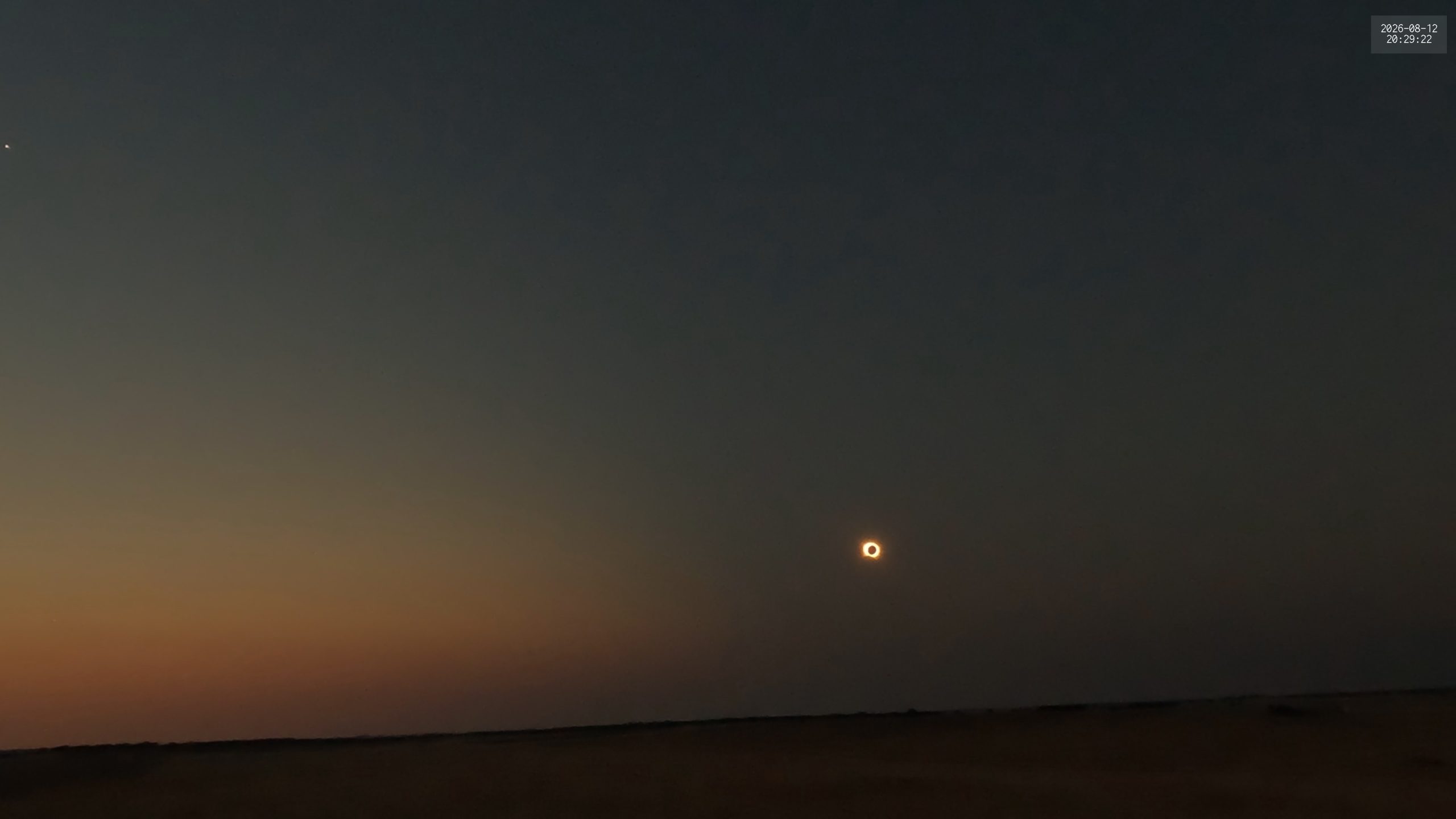
As the eclipse started, I could see the corona start to appear as the diamond ring effect took place. Then suddenly it got much darker. It was strange to see the sun so near the horizon. Because of the haze layer, the corona seemed more orangish red than the pearly white I'd seen in previous eclipses. There was a huge prominence on the left side, and the corona was distinctly flattened at the bottom.
I also tried to take a jerky panorama of our horizon, considering that was one of the features of the location that made us want to be there. The colors weren't as uniform as I'd expected them to be. I never thought to look for planets, although in my video I see Venus just on screen in one corner.
Solar Eclipse 2026 Aug 12 from Torresandino, Spain
Because of the shorter length, it was over too soon, even more than in the previous eclipses I've seen. We never saw shadow bands. The video show a plane passing over the sun within a minute of the end of totality.
For a short time, we watched the ending partial phase drop into the haze layer and turn red. By the time we left, the sun could not be seen through the #14 welder's filter we brought for looking at the sun. The group from Torresandino was still gathered on the top and appeared to be finishing the meal they'd started during the wait.
The drive back was uneventful. Not much traffic anywhere, including the autovia, so all the exploration of side roads wasn't needed. But still useful for seeing areas that don't normally get tourists. Got back with the end of twilight.
Today will be a rest day, with a less than two hour drive back to our hotel in Madrid, then an early start Friday before dawn for our flights home via London and Dallas.
Next year's eclipse will be different, as it'll be early in a cruise visiting Mediterranean islands.
A video combing my two recordings along with Suzanne's has been also posted.
Once again, geyser gazers are welcome to contact me to get a Promo Code which will allow downloading of the app for free. I'm also open to suggestions for features users would like to see added, or finding out about bugs that need to be fixed.