
First up was the CO2 cold water Mokena Geyser at Te Aroha. This was the first eruptive feature of our 2019 visit, and it was unimpressive that visit. Mostly it just spit and sputtered and made a lot of noise. But this time we got to see some real eruptions.
When we arrived there was a slight wisp of vapor coming from the vent opening. Otherwise it looked like there was little hope of observing any sort of activity. After about twenty minutes, the sound of water moving could be heard below the southernmost hatch leading to the spa intake. Within a few minutes the sound got louder and then the eruption started with no warning.
This was a thin jet of fizzy water that quickly reached an estimated six to seven meters above the vent. The jetting stayed strong for about a minute, then started to subside. By about two minutes, the jetting paused, then restarted. This activity continued for another 4-1/2 minutes, with the pauses getting longer and the heights of the jets decreasing. By the end, the height was maybe ten centimeters lasting a couple of seconds. Then all was quiet again.
There had been reports of intervals around forty minutes, and based on how long it took for us to see the eruption, we decided to stick around and catch the next eruption, assuming the interval would be in the forty minute range.
At around forty minutes, I could hear water moving again below that hatch, and within five minutes, we got a secon eruption with an interval around 45 minutes. This time the eruption didn't seem as strong or as high. I estimated the height to be four meters at most, and the first pause occurred around 1-1/2 minutes into the eruption. But the pauses and weak jetting continued for almost as long as the first eruption, finally ending at six minutes.
I reviewed my video of Mokena from 2019 and noticed a few differences. First, the vent has changed. The current one has a wider opening and is flat, while the earlier was more nozzled. Also, a section of the retaining wall at the gate was removed. So it appears that the "geyser" got a upgrade over the past seven years.
A few hours later we finally got to a real thermal area— the Tokaanu Thermal Reserve. When we last visited in 2023, we got to see multiple eruptions of Taumatapuhipuhi and an eruption of Hoani. This time we did not see any geyser activity.
Taumatapuhipuhi (#13) was in a near constant start of small ebullition over the vent, maybe 8cm high. Every so often there would be a rumble and belch from the southern end of the vent. We saw no evidence of any vent there in the previous visits. The area around the geyser show no signs of activity, but instead there was significant debris which would have been washed if it had been active. There was also some plant fragments floating on the northern end, near outlet to the trench leading to the bathtubs. The small slit I noticed last visit was also periodically spitting out some water.
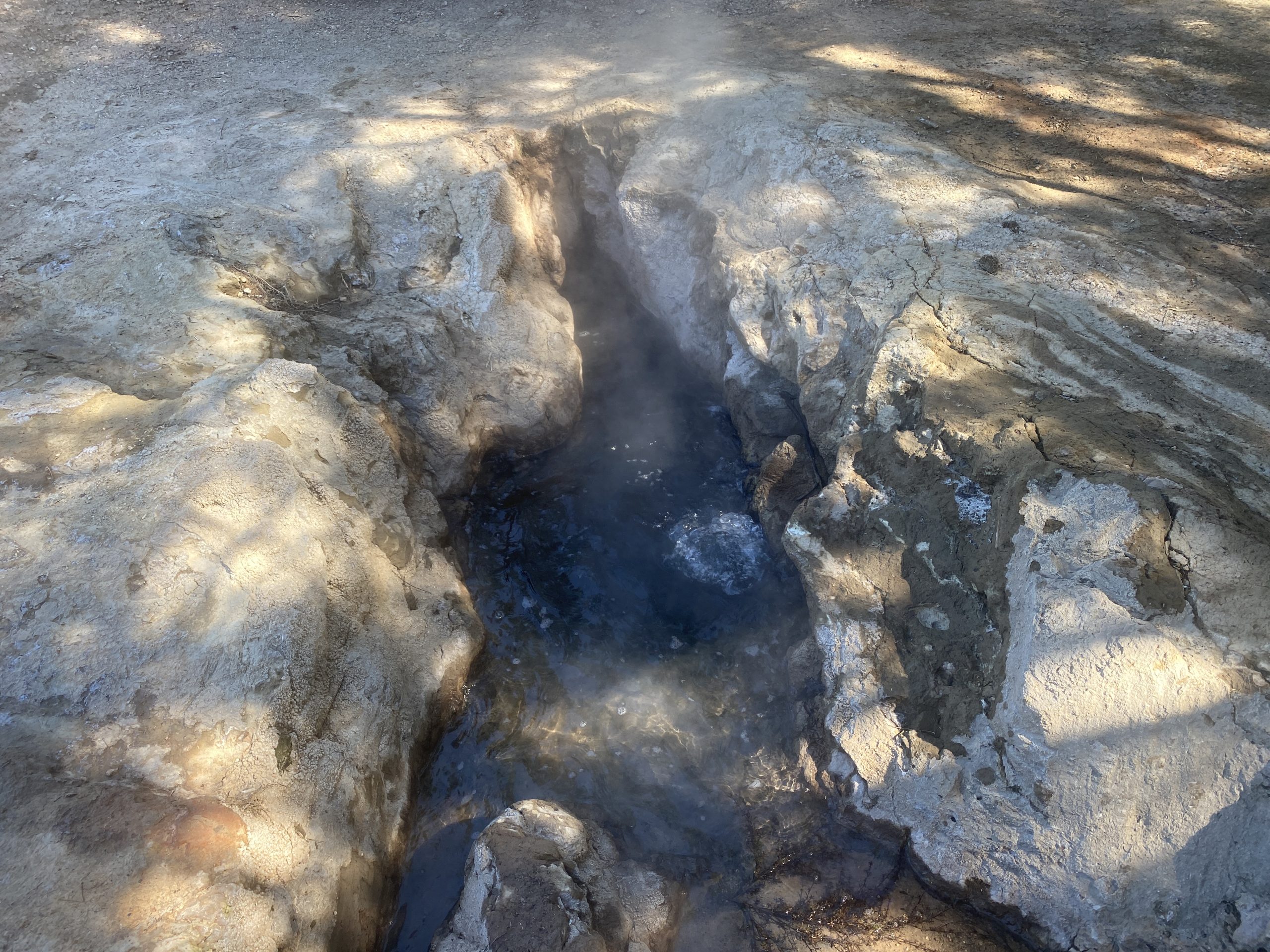
Houni (#31B) was hot, but the water level was down about a meter. It was acting as a drain for Matawei (#31D), the feature across the trail. The broad flat expanse around Hoani's deep vent has some grass growing in it, so there has not been a great rise like we saw back in 2023.
Matawai appeared to be boiling, and pouring off water which drained through a pipe leading into Hoani. Behind Hoani the feature Kirihoro (#31A) was drained, and it too had plant life growing among its formations.
It seemed like there were a number of features along the walkway that were low, because they were surrounded by dead plant life or other indications of earlier high water.
Across the street there was a new fence blocking the view of some of the features at the western end of that area, where the Tuwhare Geyser (#23A) was located. The curb on the street wasn't steaming, but it was also a relatively warm afternoon, not a damp early morning as in our earlier visits.
We may stop in briefly in a few days to check on things on our way north to Rotorua, but it was disappointing to not see what has been the only free natural geyser activity in New Zealand.