Posted on

Observations for 2026 May 22


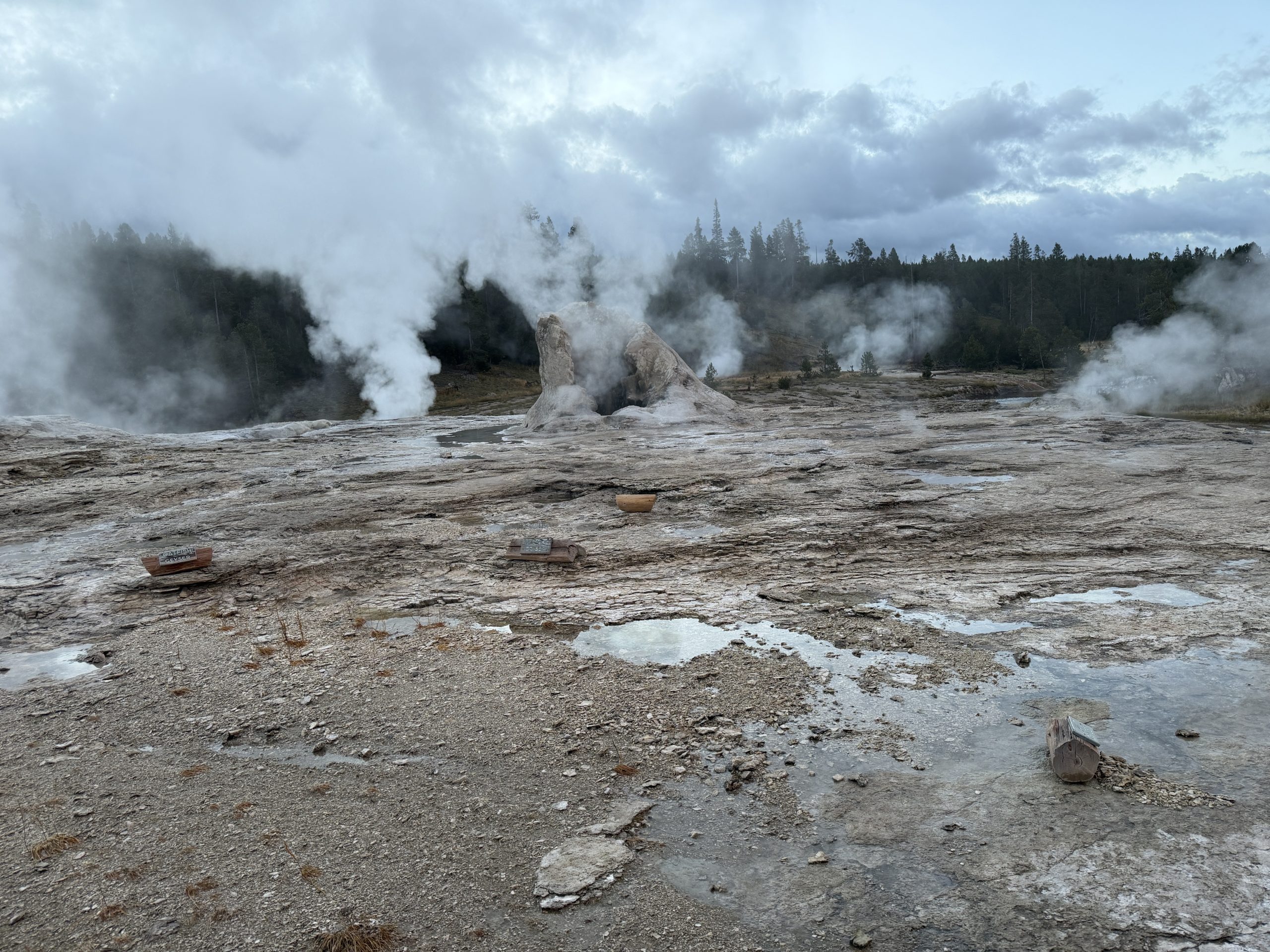
Turns out coming back in last night was a good idea. Grand erupted well after midnight with an interval of over eleven hours, with a Rift eruption during that time.

I didn't know that when I went out in the morning. Grand was in overflow, and Turban started shortly after I arrived. The duration was fairly short. Castle started a major eruption at the same time.

Grand had a One Burst Eruption with the next Turban eruption, with West Triplet starting near the end. I decided to stick around to get the duration, and make sure Rift didn't erupt. Turns out Rift did erupt, giving it an interval of less than 10 hours.

2026-May-22 : 08:09:30 T1Q

 08:09:12	Turban	-0m18s
 08:09:27	Vent Ovfl	-0m03s
 08:09:30	B1	--- d=11m18s
 08:12:32	Vent	3m02s
 08:20:48	P1	11m18s
 08:21:29	V&T Quit	11m59s
 08:42:38	V&T Restart	33m08s

				     	ΣD=11m18s
	* * * * *
 07:50:40			d=03m24s 	
 08:22:07ns	West Triplet
 08:55:24	Rift
		     Turban: 18m32s

Returned to the cabin, then decided to walk out via Geyser Hill to wait for Uncertain. I figured that there was a good chance that Beehive might be active in the next few hours. That way once the wait in the Sawmill Group was over, I could hang around on Geyser Hill for a while.

The wait for Uncertain wasn't long. Sawmill started shortly after I arrived, and that's when Uncertain started to splash heavily. Within ten minutes, it erupted, and both it and Sawmill ended their eruptions at the same time.

As usual, it was windy on Geyser Hill, and waited for about 45 minutes. Made the mistake of not waiting next to Aurum, as it erupted during that time.

Went back to the cabin for lunch, figuring I'd be out in the wind all afternoon at Grand, and could run out, as usual, for Beehive. Turns out no one called out the Indicator, and I only noticed the entry for the Indicator eight minutes after it started.

With three of the last four Grand intervals near six hours (the fourth was near twelve) I had to go out at the six hour mark. Over the next 2-1/2 hours, saw a mostly undistinguished series of Turban eruptions. The intervals slowly dropped from well over twenty minutes to less than eighteen. Then we got a Turban Delay interval.

Fortunately, Grand was able to erupt during that Delay, and it even had two bursts. The pool drained after the second burst, and there was never water visible after that.

2026-May-22 : 16:32:27 D0/G2C

 16:32:23	Boop	-0m04s
 16:32:27	B1	--- d=08m21s
 16:32:34	Vent Ovfl	0m07s
 16:32:47	Turban	0m20s
 16:35:13	Vent	2m46s
 16:40:48	P1	8m21s d=23s
 16:41:11	B2	8m44s d=01m01s
 16:42:12	P2	9m45s
Vent & Turban continue

				     ΣB=09m22s	ΣD=09m45s
	* * * * *
 14:10:10			d=03m57s 	
 14:30:50	Int: 20m40s	d=04m13s 	
 14:50:30	Int: 19m40s	d=03m30s 	
 15:09:22	Int: 18m52s	d=03m38s 	
 15:28:00	Int: 18m38s	d=03m26s 	
 15:46:05	Int: 18m05s	d=03m14s 	
 16:03:48	Int: 17m43s	d=03m30s 	
 16:32:01	West Triplet	d=37m00s
		      Grand: 28m39s

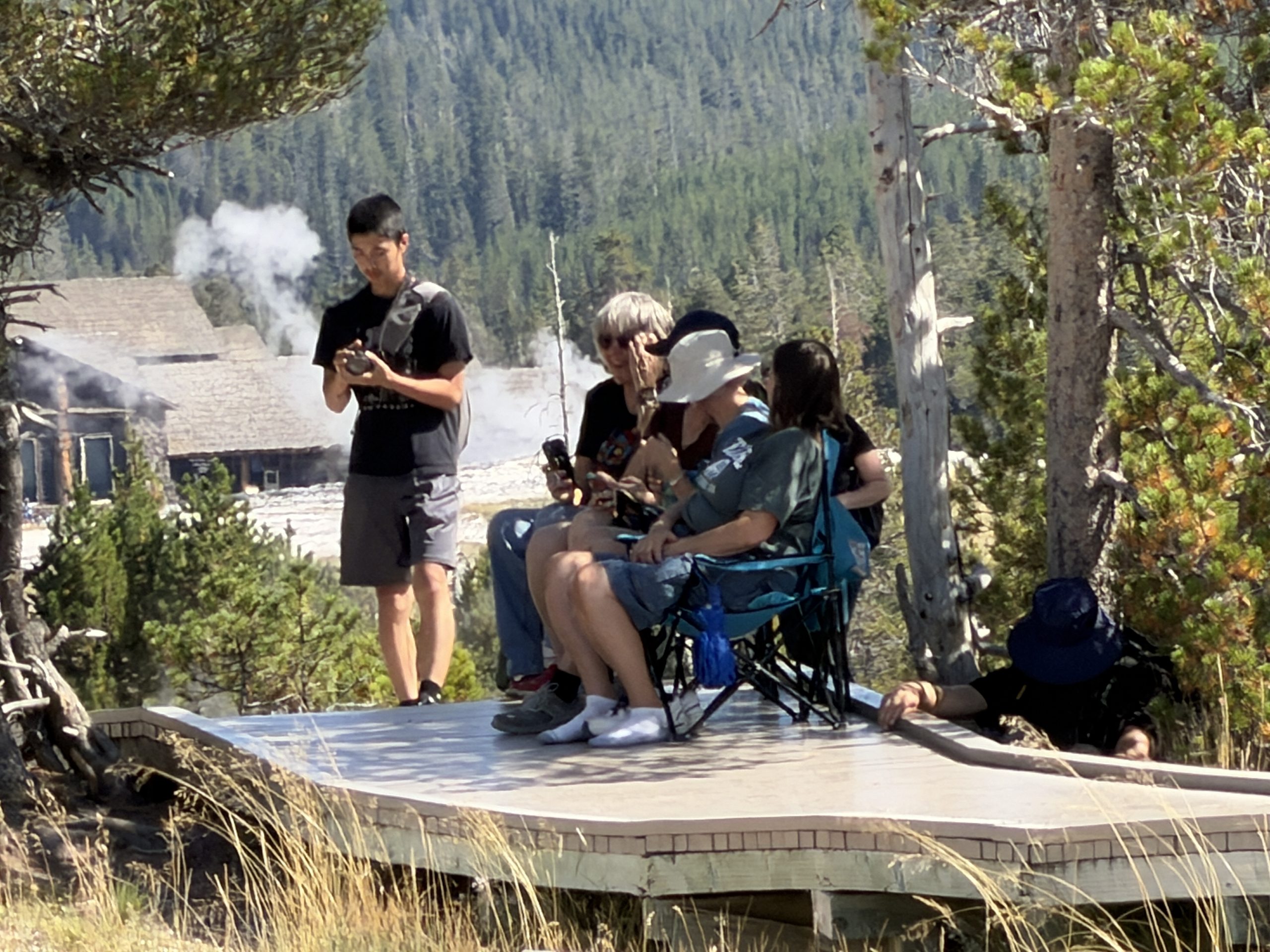
During the eruption, down by the Grand sign, there was a ground of people taking selfies. In turn, each one would step off the boardwalk and strike a stupid pose, as if they had accomplished something dramatic.

Near the start of Grand's eruption, West Triplet started. I stuck around to catch the end, just in case Rift had an even shorter interval. But while the West Triplet eruption seemed a bit long, it didn't trigger Rift.

As I was leaving, Bulger had its second observed major eruption of the day.


Posted on

Observations for 2026 May 21


Overnight we got at least an inch of wet slushly snow. By dawn, there were still light snow showers, and a strong wind from the northwest. The walkway wasn't as slippery as I expected, probably because it was slush instead of ice.

Uncertain was gurgling with occasional splashes, so I spent about twenty minutes watching it, but nothing much changed during that time. So went over to Grand. Rift's runoff channel was snow-free, indicating it probably erupted in the last few hours. Arrived just in time to catch the start of a Turban eruption. That was followed by an almost 30 minute long Turban Delay interval.

With the wind, most of the steam was being pushed to the south so that Grand's pool was easily visible. Three Turban eruption intervals later, Grand filled nicely. Turban started, and then it appeared Vent was overflowing. It took Grand nearly a minute to start erupting, after a series of boops. The wind was still making the One Burst Eruption visible.

2026-May-21 : 08:02:16 D3/T1C

 08:01:23	Turban	-0m53s
 08:01:39	Vent Ovfl	-0m37s
 08:02:10	Boop	-0m06s
 08:02:16	B1	--- d=09m29s
 08:04:30	Vent	2m14s
 08:11:45	P1	9m29s
Vent & Turban continue

				     	ΣD=09m29s
	* * * * *
 06:41:47			d=03m06s 	
 07:11:09	Int: 29m22s	d=04m20s  D0	
 07:28:27	Int: 17m18s	d=03m46s  D1	
 07:44:58	Int: 16m31s	d=03m28s  D2	
		     Turban: 16m25s

Following the eruption, stopped in at Sawmill and Uncertain again. Sawmill's pool level was high, and Uncertain was having strong splashes. Then Sawmill started, quickly overflowing as Uncertain's activity seemed to die down. At that point I decided to head back in to warm up and dry out.

With Grand having several short intervals since we arrived, decided I should not delay my arrival. The weather was dry, but windy. I had just passed West Triplet when Grand boiled up, starting the One Burst Eruption. As with this morning, the best view was at the north.

2026-May-21 : 14:16:19 G1Q

 14:16:19	B1	--- d=11m17s
 14:16:27	Turban	0m08s
 14:19:21	Vent	3m01s
 14:27:36	P1	11m17s
 14:28:29	V&T Quit	12m09s
 14:40:06	V&T Restart	23m47s

				     	ΣD=11m17s
	* * * * *
 14:26:39	West Triplet	d=26m13s

West Triplet started near the end of the Grand eruption. I waited to see if Rift might start, but West Triplet had a duration less than necessary to trigger Rift.

With all the recent shorter intervals for Grand, I decided it was better to be there early. It was just before sunset, with a clear sky and a cold wind coming from the north. I arrived to find Grand in a heavy overflow, most likely a Turban Delay interval. West Triplet had also just ended an eruption.

Four Turban eruption intervals later, there was a second Delay interval. At that point, it was dark and frost was starting to form on the boardwalks. I decided it was time to head back in.

2026-May-21 : 20:12:35

 20:22:42			d=04m51s 	
 20:40:01	Int: 17m19s	d=03m46s 	
 20:59:42	Int: 19m41s	d=03m55s 	
 21:20:06	Int: 20m34s	d=03m33s 	
 21:48:57	Int: 28m51s	d=04m25s  D0	

Posted on

Observations for 2026 May 20


Woke up shortly before the alarm, and within a minute or two got the Beehive Indicator call. This time I only made it to the Firehole River bridge before I heard the roar of Beehive's eruption. Did get as far as Anemone (both vents were erupting). Also, Little Squirt was in eruption, and the alter ground near the boardwalk was steaming heavily.

Went back to the cabin to reconfigure, then headed out to Grand as it was almost 15 hours since the eruption we saw yesterday. Arrived to find Grand in overflow. Turns out that, based on the secret NPS time, I probably saw first overflow.

For the next couple of hours, it was a series of undistinguished Turban eruptions. Finally, West Triplet started to erupt, and eruption that lasted over an hour. During the middle of that eruption, I again saw slight steam coming from the location of East Triplet. Finally, after about fifteen minutes of heavy steaming, Rift began its eruption.

That eruption only lasted about 46 minutes. Two Turban eruption intervals later, Grand had its first good overflow, and we got a steamy but backlit One Burst Eruption.

2026-May-20 : 10:10:04 G1Q

 10:10:00	Boop	-0m03s
 10:10:04	B1	--- d=10m59s
 10:12:58	Vent	2m53s
 10:21:04	P1	10m59s
 10:22:09	V&T Quit	12m04s

				     	ΣD=10m59s
	* * * * *
 06:33:35			d=43s 	
 06:49:49	Int: 16m14s	d=03m45s 	
 07:11:29	Int: 21m40s	d=04m26s 	
 07:31:11	Int: 19m42s	d=03m56s 	
 07:52:20	Int: 21m09s	d=04m15s 	
 08:07:49	West Triplet d=01h04m 
 08:12:28	Int: 20m08s	d=04m29s 	
 08:31:56	Int: 19m28s	d=03m54s 	
 08:49:27	Rift d≈46m
 08:50:41	Int: 18m45s	d=04m18s 	
 09:09:13	Int: 18m32s	d=03m40s 
 09:12:22	end West Triplet	
 09:28:32	Int: 19m19s	d=02m59s 	
 09:46:36	Int: 18m04s	d=03m20s 	
		      Grand: 23m28s

When to return to Grand was an open quesiton. I didn't want to go too early, as these long waits in the cold and wind are tiresome, but didn't want to miss a short interval. Settled on getting out at around the 6-1/2 hour mark. So Grand erupts at just over six hours. I'd just finished something to eat and was getting properly configured.

Instead I went out to wait for Uncertain. Sawmill had a short, no overflow eruption while I was watching and waiting for West Triplet to quit, and see if Rift would start. It didn't. Then Sawmill starts another eruption about 45 minutes later, this time getting strong and overflowing.

By this time Uncertain had been splashing and gurgling nicely, so three minutes later, it also erupted.

At that point it was getting colder and windier, and it looked like the precipitation could start soon.


Posted on

Observations for 2026 May 19


After last night, Grand erupted at dawn with a reasonable interval. The temperature was listed at 19. Rift erupted soon after, and had quit by the time I got out just before 09:00. The temperature was still a couple of degrees below freezing, and there were quite a few icy runoff channels around Grand.

Runoff channel north of Grand Geyser.

I also noticed that it was nicely steamy. There was nothing coming from the hillside with the sputs like Sput D and Sputnik. But there was a slight whisp of steam coming from the location of East Triplet.

Afterwards I went to look around Geyser Hill, where there were still a lot more frozen runoff channels, even at 10:00. At around 11:40, I decided I wanted to get over to Grand, and left. I was at the bridge when the "water in the Indicator" call came out. So I reversed and watched the eruption. After a morning with a consistent wind direction, it shifted three minutes into the eruption so that the boardwalk got a soaking.

A quick reconfigure at the cabin, and it was out to Grand. Arrived to find Turban in what was probably a Delay Interval, based on the Turban eruption duration and the behavior during the following interval.

Six Turban eruptions later, late in a West Triplet eruption, we got our second Turban Delay eruption. Four more Turban eruptions and we got a third Delay. Grand finally erupted two more Turban intervals later, on an interval of sixteen minutes.

Grand started with a large boop, and there were two bursts. West Triplet followed the Grand eruption, and there was a report of Rift erupting with a 11 hour interval.

2026-May-19 : 16:30:02 D4/D2/G2Q

 16:29:58	Boop	-0m04s
 16:30:02	B1	--- d=10m57s
 16:32:54	Vent	2m52s
 16:39:11	P1	9m09s
 15:39:53	B2	0m42s
 15:40:59	P2	1m06s
 15:41:36	V&T Quit
				     	ΣD=10m15s

 	* * * * *
 12:30:30			d=04m43s 	
 12:48:21	Int: 17m51s	d=03m24s 	
 13:07:31	Int: 19m10s	d=03m46s 	
 13:25:18	Int: 17m47s	d=03m13s 	
 13:44:47	Int: 19m29s	d=03m11s 	
 14:03:23	Int: 18m36s	d=03m38s 	
 14:18:22	West Triplet
 14:34:42	Int: 31m19s	d=04m56s  D0	
 14:52:52	Int: 18m10s	d=02m49s  D1	
 15:08:47	Int: 15m55s	d=03m38s  D2	
 15:25:38	Int: 16m51s	d=03m11s  D3
 15:56:19	Int: 30m41s	d=4m22s	  D4/D0
 16:14:18	Int: 17m59s	d=3m23s   D4/D1
 		     Turban: 15m44s

Following Grand we only had to wait a few minutes to have an eruption of Uncertain, and then it was time to get out of the wind and cold.


Posted on

Observations for 2026 May 18


I'd checked the road conditions before we left, and our route to Yellowstone appeared to be a bit wet, but otherwise open. That changed, because when we approached the last exit to Laramie, we encountered a line of trucks parked along I-80, because the highway to the west was closed. That was not good.

We fueled up and then I took a look at the road conditions map. Not only was I-80 closed, but so was US-30. There was, however, no indication that Wyoming-34 was closed. It branches off of US-30 about ten miles north of Laramie, and that's where the closure started. Decided to risk the ten mile drive, as the alternative was to head east to Cheyenne and then head north on I-25. If Wyo-34 was open, it would make the alternate route less painful.

It was open, but pretty slushy for much of the fifty miles. Then it was north on I-25, which was wet, but not slippery or slushy most of the way, so I was able to drive at the 80mph speed limit.

That got us to Casper, where the exit we'd intended to use to fuel up was blocked due to a collision. Fortunately, the closure was gone by the time we went back on the way to an alternate route. At that point, the conditions improved dramatically, and except for slush at the summit of Togwotee Pass, the road was clear.

So we checked in about two hours later than expected, and as we walked from the front desk of the Lodge to my truck parked by the cabins, we heard the "water in Beehive's Indicator" call. We had to go out to Geyser Hill without extra layers, and Geyser Hill was colder and windier than usual. But despite that, it was a nice welcome back.

Later we went out to Grand hoping for an eruption, but after two hours of non-descript Turban eruptions, we gave up. By then it was almost 22:00, and dark, and cold. The temperature was around 28, and windy.


Posted on

Observations for 2026 March 09


[2026 Mar 22: Updated with photo of new feature location]

Went back to Te Puia today, and the day started out looking pretty good. In the waiting room at the entrance they have a large video screen with a view of the geysers on display as you wait for your start time. While we waited, I noticed nothing that would indicate that Kereru was having minor eruptions. When we finally got out to the geyser area, we quickly confirmed that the geyser appeared to be in the pause mode before a major eruption.

The day was cool, a bit damp, but bright and sunny. The entire day, except for on ten minute period, what little wind there was blowing the steam away from us. But for about ten minutes, the wind shifted and we started to feel some of the spray from an eruption of Pohutu. That's when Kereru suddenly started to look in it was going to erupt.

The eruption was a mass of steam hidden behind the mass of steam generated by the runoff from Pohutu. There was a tour in process, so the bridge viewpoint was noisy, so not only were we unable to see the eruption, we pretty much couldn't see it, either.

That was at 09:44. Until we had to leave at the closing time of 17:30, Kereru had minor eruptions averaging about 2-1/2 minutes apart. Occasionally the interval would lengthen to about five minutes, and we would wonder if we'd just missed an eruption. There were other times that the minor eruption was so strong that we could see the water starting to flow off the terrace, as it does in the major eruption, only for the duration to be normal. So today we learned that the period of minor activity can last up to eight hours, and confirmed that it still appears that major eruptions can't be part of a minor series.

Once Kereru had the major eruption, we knew that it would be a few hours before the next opportunity, as the shortest major series has been about an hour, and the shortest pause around 45 minutes. So I took the time to walk and video the trail running from Geyser Flat to Papakura Geyser. (Pretty much the trail we took last night.) Also took the side trails to Waikite Geyser and Puapua Geyser, both of which are dormant.

At least Pohutu continued to exhibit the expected behavior it showed last night, erupting with intervals of around an hour to 1-1/2 hours. Waikorohihi and Mahanga were also fairly active. I saw several eruptions of Waikorohihi that lasted well over half an hour, and several series of Mahanga eruptions where it would erupt every minite for a few seconds.

It seemed like a fitting ending to our New Zealand geyser visits, where the activity was pretty good, but there always seemed to be a bit of a disappointment (no Waiotapu or Taumatapuhipuhi or Cascade Geyser activity, or just missing Inferno Crater overflow, for example.)

Update: During their visit back in December, Henning and Beatrice Rieske saw a new feature erupting across the bridge from Pohutu. We never saw any activity from this area, and the staining on the plant life was less than I'd have expected if it was still active.

Location of new feature in upper right.

Posted on

Observations for 2026 March 08


After five busy days, it was time to take it easier. This morning was overcast and foggy, and there was a distinct thermal smell in the air at our Rotorua accomodations.

In the afternoon, we spent a couple of hours in Kuirau Park. There have been a few changes there since the last visit. More of the area around Kuirau Lake has been inundated, for example.

Over by Tarawa Road there have were some significant differences. Many of the trails have been closed because of heavy overflow from a set of springs along the western edge. One of these was boiling heavily and continuously to splashing up to 1/2 meter, and putting out a correspondingly large amount of water. (Update: It appears from the 1998 map that this is Spring #648)

In the evening we went to see the Te Puia nighttime experience. Lots of colored lights and lasers, and two eruptions of Pohutu. And Kereru minors the whole time, and activity from Mahanga and Waikorohihi. The latter two were hard to observe due to the lighting, the darkness, the wind direction (or lack of wind) and the frequency of Mahanga eruptions.

Twice while standing on the bridge watching Pohutu, I heard a noise behind me, only to see an Australian possum scurry across the bridge to the other side.

Earlier in the day Te Tohu had some sort of wild phase, and Pohutu only had a couple of minor eruptions, so it was nice to see it had recovered. These eruptions seemed to start much more quickly than our earlier observations, and to last about ten minutes longer. Eventually I'll post some video of the Pohutu light show eruptions.


Posted on

Observations for 2026 March 07


Today was the day we took to the waters of Rotomahana by kayak to see geysers. Turned out to be an excellent day. It was cloudy at first, but quickly cleared into a cool, mostly sunny day.

We met our guide at a little after 0900 at the Waimangu visitor center and cafe. Turns out she was the same guide we had had three years ago, and was late because sheep were being moved between paddocks. (We are in New Zealand, remember?) This time we were joined by Graham Meech.

Took the bus down to the water and were on the lake by 0930. The features are all along the lakeshore, both above and below the water. There were perhaps a couple of dozen little spouters right on the water's edge. Which is surprising, as the lake level varies, and the activity depends on that level.

Recording activity while operating a kayak can be difficult, so I tried something different this time. I bought a mount for my GoPro camera that consists of a neck collar with a camera attachment, and wore this. It makes it easy to turn on/off, and just let it record while paddling. It can also be held and pointed manually when needed. The only problems were that it sometimes would get tilted, or blocked by my paddling. But with the timestamp, it made it possible to save all the times of eruptions we saw, and to review what was seen on an overwhelming day.

There are several bays separating the thermal activity, so it's not all visible at once. [I will probably update this posting in a week or so after we return home with proper or corrected names. I don't have the reference materials and maps here.]

In the first bay, we saw a number of fumaroles and steam vents well above the lake level, but the only water was from a small vent about 1/2 meter above the lake that was pouring out water.

The next bay is where the Angel Wings is located. [I need to verify names here.] Most noticeable is a perpetual spouter erupting up to a couple of meters high inside an alcove, The alcove is surrounded by golden yellow thermophilic slime. Along the lake were a couple of small spouters flowing directly into the lake.

Also here is a set of unique formations. I've referred to this as "Angel Wings", but it appears that I was wrong. Our guide didn't known of a name, but said she called it "Oyster", and that's good enough for me to use as a name. It consists of a couple of sheets of sinter and does look like an oyster or clamshell. (There's also a "Clamshell Spring" located along the creek leading from the Frying Pan Flats.) Every couple of minutes it would erupt a meter or two high for a few seconds. The force of the eruptions varied, from weak to once threatening Graham when get got a little too close.

Oyster Geyser, Rotomahana, Waimangu, 2026 Mar 07. Video by H.Koenig.

At the point separating the next bay were some features just at or below the surface of the lake. A couple of areas of strong upwelling and splashing on the lake surface, and to the left a small spouter on a slightly raised platform noisily sputtering away. Farther into the bay were more fumaroles just above the surface of the lake.

The next bay didn't have any thermal activity, so we didn't enter into it.

In the next bay was the primary attraction for the day— Pink Terrace/Otukapuarangi Geyser. One of the goals of this trip was to maximize the amount of time to observe this geyser, and were successful. After seeing few eruptions we went on to the point separating the bay from the next one. This was the last area of thermal activity.

Pink Terrace/Otukapuarangi Geyser, Rotomahana, Waimangu, 2026 Mar 07. Video by H.Koenig.

After seeing at least seven eruptions of Pink Terrace/Otukapuarangi from the kayaks, our guide suggested we put ashore for lunch. This was a surprise, and we did not expect to be going ashore. As it turns out, it's common on this tour to have lunch on the beach of the bay we skipped, but I guess we were so enthusiastic about the geyser that she was willing to do us a favor. So sat down on some on some rocks at the edge of the lake, rocks that were warmer than just being out in the sun. (Graham said he had a small steaming crack a couple of feet from where he was sitting). We ate our sandwiches and pastries while the geyser erupted three times. The only disadvantage was that it was not possible to see the splashing at the start.

Pink Terrace/Otukapuarangi Geyser, Rotomahana, Waimangu, 2026 Mar 07. Video by H.Koenig.

The intervals were about 8 to 9 minutes apart, and the durations varied a bit. At first they were about 100 seconds, while later they were over two minutes long. I would estimate the height of most of the eruptions to be about 10 meters, but some of my videos show some nice spikes going well above the general mass of the eruption. It was comparable to Kereru in height.

After the lunch we watch one more eruption from the kayaks, then headed back the way we came. We stopped in for a couple of eruptions of Oyster, then returned to the starting point.

Due to storms and wet weather of the past few years, a number of the trails have been re-routed or closed. A portion of the walkway following the creek is closed, a stretch with a number of small fumaroles and spouters. The Mt.Haszard side trail is closed, but when we walked that in 2019, we figured there was no need to do it again as there is a lot of climbing up and down and nothing but overgrown former viewpoints.

There was also a collapse of a cut in the trail near Iodine Spring requiring the rerouting of the trail up and around. This had the effect of making it much easier to see into Iodine, an actual improvement despite the steepness of the bypass.

On the morning bus ride out, the driver mentioned to the guide that Inferno Crater was overflowing. This was great news, as Inferno Crater has a cycle lasting around 38 days where it will come up to overflow for maybe a day. One of the reasons we weren't reluctant to leave the lake was because of this. As it turned out, the overflow probably stopped around the time we were having lunch. There was just slight overflow at the base of the runoff when we got there.

Another change from our previous visit is the change in the availability of toilet facilities. Previously the only indoor plumbing in the valley as at a building at the Warbrick Terrace. That building is now gone, so much so that I couldn't see where it had been. Instead there are more modern flush-type toilet as the three bus stops.


Posted on

Observations for 2026 March 06


Today it was time to visit the other half of the Wakarewarewa thermal area, the Maori village.

In order to get to see Parekohoru and Korotiotio up close, one must take the 1-1/2 hour long Village Guided Tour. Unlike the Te Puia tour, at least you are in and around thermal areas for much of that time, and it's a much better introduction to the Maori culture than just wood carving. Also you get to sample a portion of an ear of corn that's been boiled in Parekohuro.

At the conclusion of the tour you end up at on overlook onto the Geyser Flat and Bluey Pool over in Te Puia. We also bought the Geothermal Walk, so could stay all day and leave and return to the overlook. Pohotu ended within moments of our arrival.

Graham Meech was over at the bridge across Puarenga Stream on the Te Puia side, and had witnessed the last Kereru minor eruption just after his arrival, well over an hour earlier. So we knew we were about to wait for however long it took to see the expected major eruption of Kereru.

Over the next hour we saw another eruption of Pohutu start, as well as activity from Waikorohihi and Mahanga. Because of our locations, we had the better view of the latter two geysers. They can be difficult to tell apart from the bridge overlook because of their close proximity and the viewing angle and the wind direction.

Kereru's vent isn't directly visible, hidden just out of sight by the mass of sinter forming the Geyser Flat platform. But it is possible to get an idea of the intensity of the activity.

Just over an hour later we notice an increase in the steaminess coming from Kereru. At the same time, a non-English speaking tour (probably Japanese) appeared on the platform. I don't know why, but these tours seem to have to make lots of noise as they spend their time taking selfies and staring at the little view screens instead of the scene in front of them. Of course, that's when Kereru erupted, especially since the wind direction shifted so that it was headed directly toward us. (And it didn't help that my camera glitched so that I missed the lead-up to the start of the eruption.)

After than, we figured we were free for a while, and it was time to do the Geothermal Walk. We took our time, and about 3/4 hour later we were only part-way along when we got a message from Graham telling us that the minor activity from Kereru had stopped and all was quiet there. So we returned to the platform.

We didn't need to hurry back, and saw a couple of Pohutu eruptions during our wait. The second eruption seemed to take longer to start, with Te Tohu erupting for nearly twenty minutes prior, when otherwise the interval was closer to twelve minutes. This eruption of Pohutu was also different in that there wasn't much of the preliminary splashing, but instead it started climbing almost immediately, while Te Tohu got bigger and noisier.

It was the strongest and tallest eruption of Pohutu we've seen this trip. I would estimate the height in the 25-30 meter range, definitely taller than a Daisy eruption. It could easily be heard from the overlook, and it maintained the height for several minutes before subsiding.

Eruption of Pohutu Geyser, 2026 Mar 06 14:23. Video by H.Koenig.

Right after this eruption, which had a typical duration of about 24 minutes, had ended, the steam from Kereru picked up. This time the platform was empty except for a quieter couple that I think were Italians. The wind direction cooperated, and I was able to record the full eruption showing the height.

Eruption of Kererū Geyser, 2026 Mar 06 14:52. Video by H.Koenig

Following that, with a bit over an hour left before closing time, we again went on the Geothermal Walk portion of our visit. This is an area of trails and boardwalks outside the limits of the village proper that winds through an area with large pools both clear and boiling and gray and sludgy. There are some perpetual spouters, but no true geysers in the area.

(Over at Te Puia, Graham had to stay because well over an hour before closing over there, once again he saw the Kereru minor series end. Unfortunately, he had to leave before the major eruption.)

One of the noticeable things on the first visit was the color of the Bluey Pool and its low water level. This was even more obvious from the overlook. This feature is not a hot spring, but more of a large catch basin used for swimming. Several of the guides on the tours mentioned that the prevailing winds have been from the wrong direction, preventing the water from the Pohutu eruptions from filling the pool. I notice also that there were signs up prohibiting the use of the pool, including a Rāhui, which is a formal Maori closure used for resource protection (and after accidental deaths).


Posted on

Observations for 2026 March 05


[Update: Added photo of Mud Geyser eruption for reference.]

Today it was a visit to Orakeikorako. We didn't get the earliest start, and due to fogs along the way (especially thermal fogs near Waiotapu and Waikite) the drive was a bit slower than expected. So we arrived a half hour after the opening.

Immediately after we got off the ferry boat we were greeted by an eruption of Sapphire. The intervals varied, with some as short as half an hour, but we managed to catch most of the eruptions during the day. We waited for the next eruption from the overlook, which has a nice view of the entire terrace, and verified that Cascade was huffing and rumbling, but not discharging any water.

After the next Sapphire eruption, it was time to visit the rest of the area. The boardwalk near Manganese and the new collapse features has been rerouted yet again. The new features (what I called #120nw) are mostly filling in with overflow from Manganese and other features at the base of the Golden Fleece Fault. Manganese was still boiling with variable intensity. So it was time to go up to the Artist's Palette.

It was still early and a bit foggy, making it hard to see what features were making all the noise. It was obvious that on the west half of the Palette almost all the features were devoid of water. That included the large Palette Pool, where plantlife could be seen growing on the floor within the crater. Only a couple of vents (like #743) had water in them. Square Pool was steaming, and occasionally the steam would thicken as if there was an eruption down deep in the vent.

On the other size of the Palette there were a number of pools (like #797, #735) that were full and boiling heavily. At the top of the Pyramid of Geysers there was a small sputterer making a lot of noise (it was what could be heard in the fog earlier). At the base of the Pyramid, #812 was full, but not erupting the way it was in earlier visits.

After a half hour or so, I returned to Sapphire. During the wait, I saw what could be called a minor eruption, as it only erupted to about a meter high and lasted about half a minute. Twenty minutes later there was a full eruption like those seen before.

Later in the morning, right after an eruption of Sapphire, I heard noise coming from the plants to the right of Cascade. It was an eruption of Bush Geyser, which consists of splashing down in a vent hidden in, the bush. The eruption lasted just over five minutes.

It was around then that Suzanne saw a new geyser erupt. It was a small vent located on the fault scarp wall just behind The Cauldron at the base of the Golden Fleece Terrace. A check of the map showed this to be feature #123 (with Cauldron #124), and at one time it, or a feature in that vicinity, was called "Prince of Wales Feathers Geyser".

Eruption of #123. Video by S.Strasser.

While watching and waiting to see what might happen next, I noticed that Manganese Pool was no longer in overflow. This condition lasted for several minutes, at the end of which Manganese became calm and quiet. When it reactivated, the pool rose and began to overflow again. Later I was able to determine that for the rest of the day, Manganese was having a 15 minute cycle with it not overflowing for about 5 to 7 minutes each cycle.

Back up on the Artist's Palette, I managed to miss eruptions of #760 and #772. #760 continued to have activity down in its vent every 2 to 3 minutes, but I never seemed to be able to record any of this as the wind always seemed to cause the steam to head right toward me, and there were few available viewing options.

Two hours after the first eruption was observed, we all got to see a second eruption. The splashing from the small vent increased in size and vigor and a few moments before the eruption a second vent seemed to join in. The eruption itself was angled to a height we estimated as about 1-1/2 to two meters, and only lasted about 45 seconds.

Based on the interval we'd just seen, we figured there was a chance to see another eruption before the last ferry trip at 17:00. With some time to kill, I went back for another Cascade eruption, and caught the end of a Bush Geyser eruption, too.

As it turned out, this time the geyser #123 erupted with only an hour interval, catching us unaware, but luckily Suzanne was passing by moments before the start. I had decided to walk the mudpot loop, and got a text message about the eruption while I was at the farthest point on that walk. I didn't need to cut the walk short, but got out of there quickly.

We did more calculations, and determined there was a possibility of another eruption just before closing. As it turned out, we reached the hard deadline for leaving with the geyser splashing but nowhere near looking like it was going to erupt.

Finally, on the drive back, we drove the Te Kopia Road so that we could stop in at the Te Kopia Mudpots Reserve. The trail was overgrown the last visit three years ago, so I was pleasantly surprised to find it in not much worse condition. Seems that there are enough visitors there to keep the path beaten down and not completely overgrown.

Te Kopia Mud Geyser, 2026 Mar 05.

The mudpots looked the same, and this visit I knew were to look for the Mud Geyser. It showed no signs that there had been any recent activity there.

Update: For reference, I'm adding the photo of the Mud Geyser in eruption that was taken in 2009 and can be found at Sinter-forming springs and geysers of the Waikato region [Ashley Cody, Ron Keam, Jesse Lebe, Bridget Lynne, Katherine Luketina
July 2021
].

Mud Geyser Eruption, 2009 [Cody, 2021]

Posted on

Observations for 2026 March 03


Today was the day to visit Waiotapu. As usual, we arrived as early as possible. The objective was to quickly assess the situation at the Waiotapu Geyser (#70) and then based on those observations, either wait or go watch the Lady Knox spectacle.

The first thing noticed was that the water level in Rotokarikitea/Devil's Cave appeared to be down at least a meter, based on the yellowish bathtub ring above the current water line. When the sun came out, the water was the brilliant greenish, almost phosphorescent color we'd seen during previous visits.

Rotokarikitea/Devil's Cave at Waiotapu.

When we got to the geyser, it was pretty obvious that it had not erupted recently. The formations surrounding the vent were completely dry, despite it being a cold, humid morning. The vent was mostly in shadow, but there was no indication of any water visible in the vent. Twenty minutes later, everything appeared to be the same, so we decided to join the crowd headed to see the induced eruption.

There was a long line of cars headed that way, and we learned that it was possible to pay for admission at the gate there. I don't remember that being the case when we went there in 2019. In any case, that would not have altered our plans. We found some open seating down at the front, in what at the time appeared to be a location that wasn't down-wind.

The stadium was packed, more so than our previous visit, which was still pretty full. Previously, there had been a small talk about the history, the soap was introduced and once the geyser started to overfoam the guide let it be the center of attention. The eruption we saw lasted well over a half hour, and was still erupting as we left.

Crowd at Lady Knox

This time there was entertainment. The guide sang a Maori song as the overfoaming started, so when the eruption started, we couldn't hear it, despite some roaring as it reached maximum height. Then the eruption died down completely, ending at just over a minute in duration. There was no attempt at any afterplay splashing that I could see. On the whole, a disappointing experience. Years ago we managed to induce better eruptions from #42w.

We returned to the main thermal area a pretty much the end of the line of vehicles, but we did get a decent parking spot. Returned to the geyser overlook, and learned that we hadn't missed anything. The area around the vent was still dry, and even with the better sun angle, there didn't appear to be any water visible in the vent.

Also while we were gone, it got windy at the overlook location, which made observing distinctly uncomfortable. Suzanne left me to do that. Just a short distance away there were some picnic table in the sunlight where the breeze was tolerable, so I waited there for ten to fifteen minutes, then returned to the overlook to be disappointed by no change in the geyser.

Finally gave up a couple of hours later. Figured that there wasn't going to be enough time for the geyser to show signs of life before closing time. Did do some videos of Champagne Pool and the features around it. There was one vent that was splashing slightly, which was the sum total of the natural eruption activity I saw today.

Since it was just down the road, we stopped in at the mudpots again. The activity there was much more entertaining. There were a couple of areas that every so often would explode with mud thrown in all directions, reaching heights of about four meters.

Finally, on the drive back, we stopped at the trail to the Crater Lake overlook. This is a warm thermal pool at the base of Rainbow Mountain. It used to be two craters, but the one to the north was more of a mud flat. The color of the water is that milky, opalescent blue that would otherwise indicate that it was much hotter.

Crater Lakes.

At this point I'm thinking that should there be a future visit to New Zealand, there will be no need to visit Waiotapu.


Posted on

Observations for 2026 March 02


On our way north from Tongariro for our week in Rotorua, we stopped in at Tokaanu again, just to confirm that nothing much had changed. It was a cold and windy morning (at Tongariro the weather forecast included snow showers). Houni and Matawei were identical. Taumatapuhipuhi seemed to be a bit murkier (it probably rained overnight), and a stick we'd noticed was no longer in the vent, but the activity seemed unchanged.

The previous visit I had noticed sounds coming from the area to the south/left as I had entered the thermal area, but had not been able to see the source of the noise. Maybe it was because it was early and not afternoon, but this time I saw the source. It was a small sputterer, with a height of perhaps 5-15 cm, situated in a alcove at the southern edge of Huri Kariori (#11), a large pool next to the stream and entrance walkway.

After a while, it seemed to die down, and was harder to spot even knowing it was there. When we left about 15 minutes later, it was active, but still seemed subdued compared to what we saw on arrival. The few references don't mention any activity there, despite the pool having a name.

Sputterer at Tokaanu Huri Kariori (#11). 2026 March 02. Video by H.Koenig.

Later in the afternoon, we stopped at the Waiotapu Mud Pots. It turned out there was major construction on State Highway 5 and we had to wait for at least 1/2 hour to make the final kilometer to the junction road. Fortunately there are alternative routes when we visit Orakeikorako in a few days.

The mudpots looked much like they have in previous visits. They are a large, gray soupy pool with lots of thicker islands scattered mostly along the shoreline. Some of these islands were explosively active, with mud being splattered a couple of meters high. Also, near the entrance to the walkway were a couple of older, inactive mud cones about 1-1/2 meters high.

Waiotapu Mudpot cones. 2026 March 02

Posted on

Observations for 2026 February 28


First up was the CO2 cold water Mokena Geyser at Te Aroha. This was the first eruptive feature of our 2019 visit, and it was unimpressive that visit. Mostly it just spit and sputtered and made a lot of noise. But this time we got to see some real eruptions.

When we arrived there was a slight wisp of vapor coming from the vent opening. Otherwise it looked like there was little hope of observing any sort of activity. After about twenty minutes, the sound of water moving could be heard below the southernmost hatch leading to the spa intake. Within a few minutes the sound got louder and then the eruption started with no warning.

This was a thin jet of fizzy water that quickly reached an estimated six to seven meters above the vent. The jetting stayed strong for about a minute, then started to subside. By about two minutes, the jetting paused, then restarted. This activity continued for another 4-1/2 minutes, with the pauses getting longer and the heights of the jets decreasing. By the end, the height was maybe ten centimeters lasting a couple of seconds. Then all was quiet again.

There had been reports of intervals around forty minutes, and based on how long it took for us to see the eruption, we decided to stick around and catch the next eruption, assuming the interval would be in the forty minute range.

At around forty minutes, I could hear water moving again below that hatch, and within five minutes, we got a secon eruption with an interval around 45 minutes. This time the eruption didn't seem as strong or as high. I estimated the height to be four meters at most, and the first pause occurred around 1-1/2 minutes into the eruption. But the pauses and weak jetting continued for almost as long as the first eruption, finally ending at six minutes.

Mokena Geyser @ Te Aroha. 2026 Feb 28. Video by H.Koenig

I reviewed my video of Mokena from 2019 and noticed a few differences. First, the vent has changed. The current one has a wider opening and is flat, while the earlier was more nozzled. Also, a section of the retaining wall at the gate was removed. So it appears that the "geyser" got a upgrade over the past seven years.

A few hours later we finally got to a real thermal area— the Tokaanu Thermal Reserve. When we last visited in 2023, we got to see multiple eruptions of Taumatapuhipuhi and an eruption of Hoani. This time we did not see any geyser activity.

Taumatapuhipuhi (#13) was in a near constant start of small ebullition over the vent, maybe 8cm high. Every so often there would be a rumble and belch from the southern end of the vent. We saw no evidence of any vent there in the previous visits. The area around the geyser show no signs of activity, but instead there was significant debris which would have been washed if it had been active. There was also some plant fragments floating on the northern end, near outlet to the trench leading to the bathtubs. The small slit I noticed last visit was also periodically spitting out some water.

Taumatapuhipuhi Geyser, Tokaanu. 2026 Feb 28.

Houni (#31B) was hot, but the water level was down about a meter. It was acting as a drain for Matawei (#31D), the feature across the trail. The broad flat expanse around Hoani's deep vent has some grass growing in it, so there has not been a great rise like we saw back in 2023.

Matawai appeared to be boiling, and pouring off water which drained through a pipe leading into Hoani. Behind Hoani the feature Kirihoro (#31A) was drained, and it too had plant life growing among its formations.

Hoani and Matawei, Tokaanu. 2026 February 28. Video by H.Koenig

It seemed like there were a number of features along the walkway that were low, because they were surrounded by dead plant life or other indications of earlier high water.

Across the street there was a new fence blocking the view of some of the features at the western end of that area, where the Tuwhare Geyser (#23A) was located. The curb on the street wasn't steaming, but it was also a relatively warm afternoon, not a damp early morning as in our earlier visits.

We may stop in briefly in a few days to check on things on our way north to Rotorua, but it was disappointing to not see what has been the only free natural geyser activity in New Zealand.


Posted on

Observations for 2025 September 10


A moonlight Beehive eruption in the early morning, except the moon was hidden by some clouds. Along with the lights from the Inn, there was still enough to see it, so that it didn't need to be lit up.

While passing by Sulphide on the way back we caught a smell I've never encountered in this area before, that of a skunk. Didn't notice it on the way out, and was localized to just that area.

A few hours later, in the time it took to go into the Lodge and check out from our cabin, two ravens managed to open the pocket on my bike handlebars and empty the contents out onto the pavement.


Posted on

Observations for 2025 September 09


By getting out at the eight hour mark, only ended up waiting for Grand for an hour. It was cold and clear, so the moon was bright. The One Burst Grand eruption was short enough that it could've had a second burst, but the slowing down during the final minute seemed like an indication that once it ended, Grand wasn't going to restart.

2025-Sep-09 : 03:16:04 T1C

 03:16:00	Turban	-0m04s
 03:16:04	B1	--- d=08m54s
 03:18:25	Vent	2m20s
 03:24:59	P1	8m54s
Vent & Turban continue

				     	ΣD=08m54s
	* * * * *
 02:33:28			d=03m46s 	
 02:52:33	Int: 19m05s	d=03m33s 	
		     Turban: 23m27s

Beehive erupted just before the start of the Grand eruption window, so many were able to see both eruptions. Ended up waiting for about 1-1/2 hours before the start of a West Triplet eruption, then we needed to wait until West Triplet was nearing the end of its eruption before we got another One Burst Grand eruption.

This eruption had a definite false pause around the nine minute mark before its sudden resumption of activity for another 1-1/3 minutes. West Triplet quit at about the same time as Grand, and Rift still hasn't made an appearance in several days.

2025-Sep-09 : 12:24:12 T1C

 12:23:13	Turban	-0m59s
 12:23:33	Vent Ovfl	-0m39s
 12:24:06	Boop	-0m06s
 12:24:12	B1	--- d=10m19s
 12:26:44	Vent	2m32s
 12:33:11	FP	8m59s
 12:34:31	P1	10m19s
Vent & Turban continue

				     	ΣD=10m19s
	* * * * *
 10:38:42			d=04m02s 	
 10:55:56	Int: 17m14s	d=03m38s 	
 11:14:29	Int: 18m33s	d=03m19s 	
 11:31:11	Int: 16m42s	d=03m35s 	
 11:48:37	Int: 17m26s	d=03m41s 	
 11:58:16	West Triplet
 12:06:00	Int: 17m23s	d=03m37s 	
		     Turban: 17m13s

It was after sunset, but still light, as I headed out for the next Grand eruption. As I approached the signboards and junction by the lift station, I noticed three deer right next to the bike trail. One ran across the trail into the trees, while the other two stared at me for a few moments, then went bounding off into the meadow toward Old Faithful and Geyser Hill.

I had just tied down my bike at the bikerack near Castle, and was walking toward Crested Pool when Castle started to erupt. It being a windy day, I quickly went the rest of the way toward Tilt to watch what turned out to be the second major eruption of the day. By that time I'd already seen that Rift was in eruption.

Rift erupted for another hour. Two Turban eruption intervals after Rift had quit, Turban had a strong, but short eruption. The next interval was short, and there was little overflow from Grand. So it wasn't a total surprise when the next Turban eruption started strongly. Others waiting for Grand were illuminating it, and I could see at least one boop before the One Burst Grand eruption started. Once again, we got an eruption lasting less than ten minutes with no attempt at a second burst.

2025-Sep-09 : 21:35:42 T1C

 21:35:24	Turban	-0m18s
 21:35:37	Boop	-0m05s
 21:35:42	B1	--- d=09m30s
 21:38:19	Vent	2m37s
 21:45:12	P1	9m30s
Vent & Turban continue

				     	ΣD=09m30s
	* * * * *
 20:04:06			d=03m14s 	
 20:22:18	Int: 18m12s	d=03m22s 	
 20:41:44	Int: 19m26s	d=03m59s 	
 20:59:36	Int: 17m52s	d=02m58s 	
 21:16:38	Int: 17m02s	d=03m06s 	
		     Turban: 18m46s

Posted on

Observations for 2025 September 08


The Beehive's Indicator call came in about an hour before the time the alarm was set. It was hours before dawn, so nicely backlit by the almost full moon.

Took a short nap, then went out for a 2-1/2 hour wait for a One Burst Grand Eruption. At first it was dark and mostly clear, with the moon a couple of hours from setting. As it got lighter, the fog formed so that by the time Grand finally did erupt, it was not possible to see into the Sawmill Group from the trees by Rift. Uncertain erupted, and I couldn't tell that until I got closer.

2025-Sep-08 : 07:26:05 T1Q

 07:25:48	Turban	-0m17s
 07:25:58	Vent Ovfl	-0m07s
 07:26:05	B1	--- d=11m15s
 07:28:40	Vent	2m35s
 07:37:20	P1	11m15s
 07:38:26	V&T Quit	12m21s

				     	ΣD=11m15s
	* * * * *
 05:03:08			d=04m47s 	
 05:20:43	Int: 17m35s	d=03m51s 	
 05:38:39	Int: 17m56s	d=03m47s 	
 05:57:45	Int: 19m06s	d=03m45s 	
 06:15:11	Int: 17m26s	d=03m19s 	
 06:33:11	Int: 18m00s	d=03m51s 	
 06:51:13	Int: 18m02s	d=03m43s 	
 07:09:22	Int: 18m09s	d=03m28s 	
		     Turban: 16m26s

A bit later headed out with the intention of waiting for Oblong. The large steamcloud I saw while riding past the Lodge said that we were a bit late. So instead went Fan & Mortar to see what it wasn't doing.

As I arrived, Bottom was erupting, and Fan's High and Gold vents had high water levels and were erupting vigorously. That activity died down, and over the next couple of hours, there were a series of more ordinary cycles which were never really strong.

Just as about to leave came a radio call about some interesting activity by East Sentinel. The boiling was quite strong, and cyclic. Every fifteen to twenty minutes, the right side would increase in activity and pour water over the side nearest to us. Occasionally the left side would show some activity, but only briefly. It looks like East Sentinel needs to be watched for an eruption.

By then it was time to return to Grand. On the way back, Rocket had a major eruption start just as I rode up. Shortly after, the guy dumping boardwalk pieces fired up his powered wheelbarrow, providing an unwelcome amount of noise. Rather than put up with it, I left.

Arrived at the Grand Group with West Triplet in eruption. Grand spent the next two hours never trying to erupt. Then we got a Turban Delay interval, and four more Turban eruption intervals later Grand finally appeared ready to erupt.

It was a slow start with almost a minute between the start of Turban and the start of Grand. It was a pleasant surprise when the first burst ended at 7m20s. I had just been joking about how we never seemed to get short first bursts any more.

The pause was pretty normal, and Grand didn't play around too much prior to the second burst. That burst wasn't long, and after it quit, it seemed like Grand was sloshing more than normal, with jets of water coming from the vent, when suddenly the pool drained. The eruption lasted less than nine minutes. West Triplet started just before the second burst started.

2025-Sep-08 : 18:12:32 D4/T2C

 18:11:40	Turban	-0m52s
 18:11:43	Vent Ovfl	-0m49s
 18:12:27	Boop	-0m05s
 18:12:32	B1	--- d=07m20s
 18:14:49	Vent	2m17s
 18:19:52	P1	7m20s d=39s
 18:20:31	B2	7m59s d=46s
 18:21:17	P2	8m45s
Vent & Turban continue

				     ΣB=08m06s	ΣD=08m45s
	* * * * *
 14:59:15	West Triplet
 15:00:27			d=03m04s 	
 15:19:21	Int: 18m54s	d=03m38s 	
 15:37:40	Int: 18m19s	d=03m34s 	
 15:56:59	Int: 19m19s	d=03m28s 	
 16:15:47	Int: 18m48s	d=03m29s 	
 16:34:01	Int: 18m14s	d=03m26s 	
 17:03:31	Int: 29m30s	d=04m53s  D0	
 17:20:42	Int: 17m11s	d=03m13s  D1	
 17:36:49	Int: 16m07s	d=03m41s  D2	
 17:54:40	Int: 17m51s	d=03m50s  D3	
 18:20:26	West Triplet
		     Turban: 17m00s

Even with the short eruption duration, Grand didn't seem to have any afterplay.

Did not stick around for the end of West Triplet, or a start of Rift as it was pointed out that this was an ideal time for an eruption of Great Fountain. So left quickly, and when we got over to the cabin to load up the bikes, learned that overflow had started about a half hour prior. So we had plenty of time to drive out and bike over.

The sun was about to set, and it was below the horizon when Great Fountain finally did erupt. But it was still well lit, and after a few preliminary surges, we got a huge burst that sent out multiple waves across the terrace. Not a superburst, but still impressive, and it all showed up nicely in the recording I made. Didn't stick around much longer, as no one wanted to deal with biking back in the dark.

On the drive back, I did get to encounter just over the Biscuit Basin bridge an oncoming van that just had to get in front of someone else even though I was coming right at him. At least I didn't have to deal with any bison on the road.

In the cabin area, the elk continue to bugle off in the distance to the south.