Another quiet day. Saw a couple of Grand eruptions, even got a second burst for one of them. Spent time at Fan & Mortar mostly to kill time.
After the second Grand, headed out to Imperial Geyser at 17:00. The parking lot was crowded, but all those people were on a quest to fill one more item on their bucket list. Beyond the overlook we met a few people coming back. Beyond Fairy Falls we encountered three employees who were at the top of the butte when we arrived at Imperial. (How do I know they were employees? They were hitchhiking back from the parking lot as we left.)
This is the first time I haven't gone out there in the morning, so was a different experience. The lighting and lack of steam made Imperial's activity even more impressive. The runoff channel, based on the dead trees that aren't being flooded, has shifted a few times lately. Only watched Spray for a bit, but did see both vents active (the one on the right doing most of the work, but on the left splashing to a foot or so.)
We were the last out of the area, and there was only one other vehicle in the parking lot when we left.
After the midnight hot period, I decided that I needed to be out at least 4 hours later for the next activity. So I ended up waiting in the dark, with approaching lightning and rain for what turned out to be a bathtub. Quite disappointing, especially since the rain started as I untied my bike at Grotto. I went in for a couple hours of warming up, drying off, and maybe getting some sleep.
So it was a bit annoying to be waiting for the alarm to go off only to hear that another hot period had started about two hours later. Rushed out to see the end of a moderately strong hot period, and to get rained on again on the way back in.
So now it's time to not make any assumptions, unless willing to miss another hot period start. An hour later there was a long, 6min pause, which confirmed that suspicion. Going to wait until the next big hot period, then figure out how to get a break.
Four hours after that strong hot period, we got another long Bijou pause with visible Mastiff water. It barely qualified as a bathtub. A bit after five hours, we got a weak, Feather-only hot period. The only anomaly was that we did get Cave erupting weakly for a short time, despite none of the other vents, especially Feather's Satellite, doing much. But it was a sign I could head in for a bit.
Two hours later, having eaten and gotten cleaned up, I got back just in time for another long Bijou Pause. Forty-five minutes later, Bijou started having slowdowns, but nothing close to a real pause. Then, around the 70 minute mark, which seems common, a pause started,
This pause was slow to build. It seemed like all the other features were taking their time in getting started. It was four minutes before Feather finally started, and another twenty seconds before Mastiff started to overflow. It took Feather's satellite almost 2-1/2 minutes to get to overflow, a minute after Cave started. Mastiff didn't boil all that high, either. But that's when the fun began.
When Mastiff dropped, and Bijou came on, Feather didn't quit. When Posthole came on, Giant started surging. The surging was small at first, but the water level was high. Often we could see the boil up in the vent before and after a surge. Over the next few minutes, they just kept getting better. I commented that if it didn't erupt this time, it was going to be a while until the next attempt at erupting.
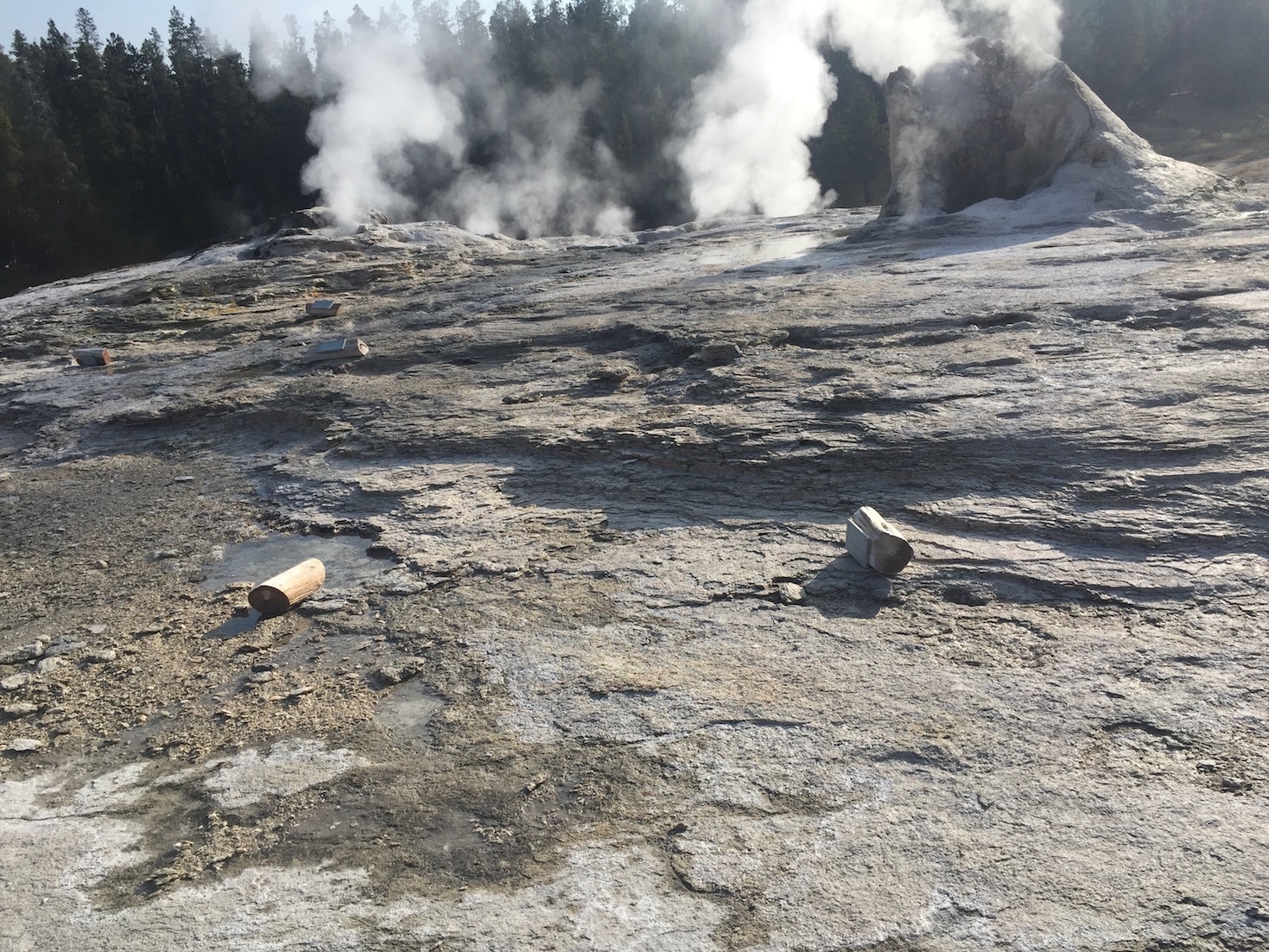
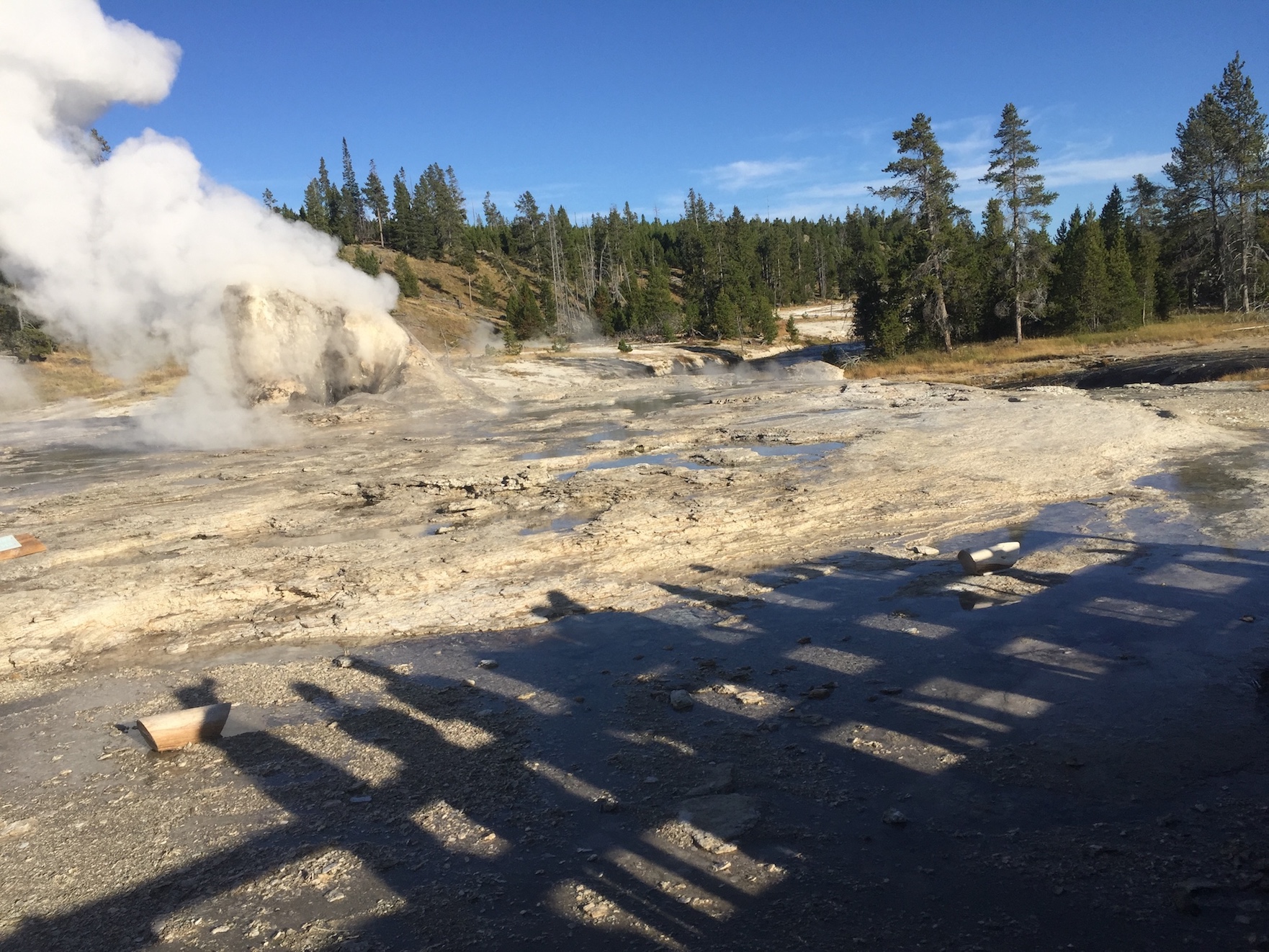
Giant Signs Locations
Then we got a massive surge well above the cone, one pouring out water. Two more even larger surges and Giant was in full eruption. It was windy, but the direction of the wind was away from us. It pushed the water column to the northwest, such that those of us standing at the northern corner of the Cage had to look straight up to see the tops of the jets. It was also mostly sunny, so back a ways, on the boardwalk, there were rainbows stretching from Giant northward.
After the first minute or so, I rushed back to the baseline to get a height. I got 85% of 60meters, which comes out to 51meters, or only 167 feet. Like the pervious eruption, even with the wind pushing the top of the column away, that seems way too short. It sure felt much higher than that.
As I went to get the height measurements, I also noticed that Grand had just started erupting. I don't think many people cared about it. But because a lot of people had headed up there for that eruption before the hot period started, there were a lot of gazers on the boardwalk back there instead of being in the cage.
The end of the eruption seemed to drag out, making it hard to tell when the end finally came, and making it one of the longer ones in a while. It was a great eruption under excellent conditions.
While waiting in the morning, I got to see a private tour-group get part of their talk in the cage. There were two guides, and instead fo talking about Giant, the subjects were The Gumper (over at Mud Volcano) and how to properly visit a backcountry thermal area. The first guid made it sound like The Gumper is way off and inacessible. Back in 1983, when I went there a few times, the hardest part of getting there was not being seen when you left the established trails at Mud Volcano.
The second complained how he was no longer able to take people to see Tomato Soup Spring up Rabbit Creek as a group, but people were able to go up by themselves. That got me to thinking...
I disagree with the NPS closures of all these areas, but I also thought that it was people like him who caused a lot of the problems. Most of those people wouldn't be hiring him if they were willing or able to visit the thermal areas on their own. Most of those people probably had never see a geyser or mud pot or large hot spring before. Why do they need to see some obscure feature like Tomato Soup Spring? (One I've never visited, either). Because, thanks to things like "social media", people have gotten the idea that they don't need to spend any time to become familiar with the common features and activities, but must jump straight into the rare and unusual and "unique". Gotta fill in that bucket list, even if you have no idea why those features are on the bucket list you are required to fill in "before you die."
Besides, what good is a guide if all it can show you is what you'd find on your own, or could read in a book? The guide needs to be able to take people back to rare and unusual areas (and help ruin them in the process) in order to justify getting paid. (The same goes for the "Secrets of..." type books.)
(As for the closures and what to do about them, I have some ideas based on my experiences in NPS units in Utah. They could work, but I don't know if the NPS here could be trusted to do it right.)
Left a half hour later today so we would not be driving to Norris in the dark. Arrived in the parking lot there to discover that, not surprisingly, there were already quite a few gazer vehicles there.
The day was cloudy and didn't warm up as fast as yesterday. So by 10:15, I had not shed any coats, and didn't really feel the need to. That was when the fun began.
There had been some gazers at the platform during the night, and they reported a series of strong minor play around 05:00 or so. So it wasn't too surprising that New Crater wasn't showing much activity for the first few hours. That changed shortly after 10:15, when it began having a quick series of strong minors. I hadn't set up my tripod, and half-way through trying to do that, realized I should just forget it and start recording.
So I caught another minor, and it dying down. Almost immediately, another one started. Then it became obvious that the North Vent was building and climbing, and we were getting our eruption. The water briefly hit the platform, but that was the only time during the eruption that there was any threat of getting wet.
Since it was early, I decided that it was the time to try for a height measurement. I'd already determined that the bench on the boardwalk leading to the platforms would be a good place to work from, so I quickly moved there. Unfortunately, the sun and the top of the North Vent water column were close together, making it hard to get a reading at first until I could work out a way to shade the clinometer. About 4 minutes into the eruption, at 130 meters, I got a reading of 80%. That works out to 104meters, or about 340 feet. I haven't yet determined the altitude difference between that location and the vent, and need to confirm the distance, but that value sounds about right.
After that, I took advantage of the lack of crowds to head down to the runoff. The amount of water coming down both of them was impressive, The main one had obviously flowed over the walkway for a while, but was back below the bridge when I got there.
I returned to the platform, and now things were getting crowded. It gets really annoying when tourists who spent no time waiting try to elbow their way to the railing in order to get their precious selfies. I wasn't the only gazer who wasn't helpful in their trying to acheive that goal.
The North Vent column was reddish brown again, while the South was a clean white. Because of the wind direction, there was considerable wash from the hillside behind the North Vent, and I am sure that's where the color comes from. The water phase lasted about 43m, and it wasn't until then that the North Vent finally lost the brownish color.
There was only a light coating of the parking area, and despite the mid-day gridlock, were able to get out of there reasonably fast.
On the drive back, in the Fountain Flats we got to see the first bison herd of the autumn make its appearance. He had to see it, because the traffic was backed up to the Nez Perce bridge. Must have been about 100 of them out there.
No Giant eruption while we were gone, was a bit of a relief, but would have accepted it, considering. Got back in time for a weak, Feather-only Giant Hot Period. Figured that meant there was time to see Grand. Which had its first long (7 hours) interval in quite a while. So a bunch of people all abandoned Grand when a Bijou pause turned into a Feather eruption.
That one was strong enough to have a restart, but no eruption. Not trusting it, I came out at night at the four hour mark, expecting to see that I just missed another, but instead waited until almost midnight for another, similar hot period. Things there are starting to look like last interval, where we had several days of medium to strong hot periods every 6 hours or so.
Spent 10 hours at Norris. It's early, but worth checking out since it has had a couple of short intervals. The prognosis was "good but not great". It wouldn't surprise me if it went during the night, or took the better part of a week.
At around 15:00, we could smell smoke, and by the time we left two hours later, it was almost overpowering.
Shortly after arriving, we learned that Giant had had a nice strong hot period in the morning. We arrived back in time to head down at around the 11 hour mark. Didn't have long to wait before a moderately strong one occurred. There was plenty of Mastiff overflow during the 8min eruption of Feather, and a quick restart (1m09s pause) that lasted 4m19s and had about 15 seconds of what looked like Giant surging from a high water level. Like New Crater/Steamboat, I could see Giant erupting tomorrow or next week.
After that, got sucked into waiting at Fan & Mortar. Not sure if we saw a Gold Pause, or two very weak cycles. Sometimes I wonder if we are all watching the wrong things, and that a lot of "event cycles" are just weak cycles that have Main Vent acting up. Sometimes hard to tell the difference.
Looks like we are settling in to having regular Giant hot periods. Saw a strong bathtub in the morning, then mid-day it was a medium strength hot period with a weak restart and not much Giant surging.
I did go up to Daisy to see an eruption upclose, and to see what Splendid is doing. The answer is not well. Daisy was 3m26s, which would be short back when Splendid was active. Splendid itself did nothing prior to Daisy's eruption. Afterwards, there was some weak Side-Boiler action to maybe 25cm for a few minutes before the boiling shifted to the Main Vent area. There are two small areas of orange near Splendid where the runoff channels used to start.
Right now, if you didn't know that Splendid was a large geyser, you'd just assume it's a fairly quiet hot spring with a few sputs along the northwestern edge.
Another day like the last couple, but this one did start getting different.
Giant started showing signs of life. I saw a couple of 6 minute pauses/bathtubs, and there was a short Feather-only hot period observed. Not sure what it means.
Also got an entertaining One Burst Grand in the middle of the day. The first Turban interval was well over 30 minutes, and for some reason, all those gathered around got all excited by a call of waves on the radio. I sure didn't see any. That resulted in a long, 7m duration Turban eruption and a thoroughly drained Grand. But the water level slowly rose over the next twenty minutes, despite there not being much overflow.
When Turban started, Grand wasn't abnormally low, and as the eruption progressed, so did Grand's water level. But no one seemed to notice or care, as the socializing continued. After a minute, Vent started overflowing, and still no one noticed. Finally, as water started pouring off in waves, the assembled group quieted down and concentrated on the geyser. Grand erupted 1m45s after Turban started.
Also wasted some time at Fan & Mortar again. There never was any real attempt at an eruption.
I also went out for the nighttime Grand. With the regular 6 hour intervals, it's nice knowing that I'll have to only wait a Turban interval or so.
News in the morning that New Crater/Steamboat had erupted shortly before midnight was a bit of a relief. After days of trying to get out to Giant for every hot period, and succeeding most of the time, a day off was nice.
So I saw a couple of Grand eruptions, both in good conditions, and one actually had a second burst. I also went up to watch Daisy, and during the wait, Splendid was a calm hot spring. After Daisy I saw a bit of Side Boiler activity followed by some surges in the Main Vent, but nothing even close to what it looked like when active.
Otherwise the rest of the day was wasted at Fan & Mortar, which is typical for those sputs.
Got out to Bijou Cage about 3h45m after the midnight hot period. Turned the corner and noted that Riverside was in eruption, which I hadn't noticed while tying the bike at Grotto. Dropped the pack and was fishing for my notebook when I realized that the noise on the platform didn't seem right, too noisy, and one of them sounded like Feather. Got the spotlight out of the pack to discover that Feather was not only in eruption, but Giant was surging. It was a restart. But after a couple of strong Giant surges, things died down.
Just as the alarm went off, Mike Keller started to announce a fill in Mastiff. This turned out to be a strong bathtub with Southwest Vents, but it was still just 2-1/2 hours since the last activity. This gave us the chance to take some time in getting ready to head out.
Arrived at the Cage just before 07:00. Grotto was active, but nothing much else was going on. Rocket finally erupted about an hour and a quarter later. There was a series of pauses lasting from 45s to 1m20s until we finally got a long, 3 min. pause at 10:30. I used that as the opportunity to make a quick run to the cabin to remove some clothing layers and get ready for a longer wait. As I arrived at the cabin, I heard that Grotto had started another eruption.
That eruption of Grotto was short, with Rocket just 26 minutes later. The series of Bijou pauses continued for several hours more, with another Grotto eruption with an interval of about 3-3/4 hours, one that had no Rocket eruption at the end.
Finally, 13-1/2 hours after the previous hot period, we finally got a long pause and Feather. The water rising in Mastiff took its time, about three minutes, to make itself visible. It was another two minutes before Feather started. Then things started happening. Mastiff overflow was strong, and kept getting stronger. The surging was as high as any of the good hot periods. After about 5 minutes, the surging turned into an actual Mastiff eruption.
Over the next couple of minutes Mastiff kept getting higher, with some bursts at least three times the height of Giant's 10 foot high cone. At that point, Giant, whose water level had been high for quite a while, joined in and within two minutes we had the first Mastiff function eruption since late April.
At the platform, I had set up a camera on a tripod to record the hot period, while near the end I started recording the hot period with my phone. As the eruption started, the water was thrown our way, soaking the north end of the cage where I was. The water was still warm, and I quickly shoved both cameras into pockets to protect them. (Videos will be posted when I get back home).
Then I rushed, as much as I could, to get to the 60 meter baseline marker. The boardwalks were crowded with people, but I was there within the first few minutes of the eruption. The best height measurement I got was 74% of 60 meters, which works out to about 150 feet.
The eruption didn't look that short, it looked huge. But I also know that the angle to the top of the spikes was less that 45°. I reviewed my procedures, and confirmed that the baseline I was using appeared to be the 60 meter one (unless the baseline got moved by a repair). The only thing I can conclude is that Giant must've put up some massive spikes at the beginning, but quickly settles down to something not as high. (Much like what Grand does.) Or all those heights of 200+ feet were not based on measurements, but were optimistic estimates.
I do know that years ago I measured a height, well into an eruption, at 72 meters from that point. That eruption was definitely more than 45°. Not sure to make of all this.
The weather conditions were almost perfect. There was a bit of wind, but after the intial surge, the cage didn't get wet again, and the wind pushed the steam away to the north. It was late afternoon, so there was a full double rainbow seen from my vantage point in the cage.
Signs Final Locations
Two signs, the Giant sign and the "Danger" sign rolled from their locations down in front of the cage platform.
The next hot period was just under 6 hours after the previous. It had a restart, but that pause was long, the restart was short, and there wasn't much going on besides Feather. It was perhaps the weakest of this series over the past few days.
Since Grand and Giant were not in sync, waited less than a Turban interval for a One Burst Grand eruption, then headed back to the cage.
Almost immediately, there was a long Bijou Pause. Even though 4m22s long, Mastiff never had water. This seemed a good sign, that there might finally be a longer interval. Which is what happened. Three hours later, we finally got the hotperiod, with an interval of 8-1/2 hours. The surging in Giant was great, but not enough to result in an eruption.
After that, had another opportunity for a One Burst Grand eruption. Which is what it did.
At sunset we had yet another hot period with an interval of 5-1/2 hours. It wasn't as weak as the early morning, but was pretty obvious that it wasn't going to result in an eruption. It took a long time (2m34s) for Feather to restart, and when it did, it was the only vent erupting and it lasted only 3 minutes.
Based on this, I figured that I next needed to be out in the cage after midnight. So it was quite a surprise to be awakened well before the time my alarm was set by Tara reporting a hot period in progress. One with an interval of a little over 4 hours. Started the mad dash to get dressed and ready enough to head out. Didn't get very far when she announced that things were winding down. Was a relief, but now I wasn't sure when to head back out. Decided that I should be there in time for another four hour interval.
As I commented yesterday, the sameness of the hot periods continued. Went out in the dark and at a little over 7 hours got another in what would be a series of increasingly disappointing hot periods.
They were coming more frequently, with the one before midnight having an interval of about 5-3/4 hours. The surging in Mastiff seemed similar, but it was when Feather quit that things worsened most. Giant was showing less surging each time, and the pause before the restart was getting longer and then the restart itself was getting shorter. Not sure what it all means, but it's becoming disappointing.
The weather was much improved. Which the first hot period in the morning was in the freezing dark, for the daylight ones it was bright and sunny and almost hot. Except when there were clouds, and then the cool air temperature became obvious. The wait for the one before midnight was actually more pleasant because there was a layer of clouds obscuring the rising half moon.
Because my priority has been to wait for Giant, I've not seen many One Burst Grand eruptions this trip. And lately the intervals between the two have been about the same. So the nice thing about the day was that they were so out of phase that I finally got to see a couple. One of them was even a two burst eruption.
After last night, I decided that six hours was the magic interval. The temperature was well below freezing (the weather site said 29°F, but because it was a dry night, there wasn't much frost. I arrived at the cage at 04:30, and I timed it pretty well. At 05:04 there was a fairly strong hot period, with feather restarting, but again, not much surging in Giant. It was just starting to get light, but I could still go back in and get a couple more hours sleep.
Four hours seemed a good bet for the next opportunity, so was out there well in advance. Bijou was having short pauses about a minute long every 20 minutes or so. Nothing changed when Grotto started, but within seconds of the start of Rocket, Bijou paused and within a minute water was visible in Mastiff. This was another one of those weaker hot periods, where we got Feather's Satellite, but no overflow or surging in Mastiff.
The hot period was quite strong, until it was time for Giant to start surging. Despite what appeared to be a high water level, it never seemed to try to start erupting. It was amusing after the hot period was over because there were several vertical surges that were probably higher than anything during the hot period.
After the hot period, about 70 minutes later, activity from the Southwest vents was observed. Don't know if this was unusual, or normal. No one really hangs around Giant for several hours after a hot period, so this might be normal. In any case, I waited around a bit, and about an hour later there was a normal 1m39s Bijou pause. About the same time interval after that was a report of water in Mastiff. So not sure what was going on there.
Did get a real strong hotperiod about when expected, at 23:04 for a little under 7 hour interval. It looked like the last few hot periods, and we are starting to get a sameness to all of them. The most telling part is how Giant just does not seem to do any strong surging, and what surges it does have are later, after a lot of wasted effort.
The last couple of nights I've heard an owl off in the trees across the river from the cabins. I've heard another one over north of Castle on occasion, too.
This day started overcast, foggy, cold, and damp. But it was still more pleasant than the previous day.
Got to the cage in time for another Southwest Vents Bathtub. But I never did see the water level in Mastiff, I only inferred it from the fact that I couldn't hear Bijou and the vents were erupting. It was that foggy.
Then, like the previous day, it was a four hour wait for the hot period. This one was even weaker than before. Feather really tried hard to not restart, but eventually it did. During that Giant made a few half-hearted attempts at surging, but never anything to get excited about.
By that time, the day had warmed up to would be nice in October. Later in the afternoon there was time to catch a One Burst Grand, from where I saw a long Bijou pause. So it wasn't surprising that when I was in the cage an hour later, there was a minor, Feather-only hot period.
I had to figure out when to head out during the night. I decided that the second Grotto eruption would be the best time, and set my alarm for 01:00 in order to be out there in plenty of time. So had just turned out the lights in the cabin when we heard Tara start announcing a hot period. Lost that bet, but kinda glad since I would've been sitting in the cold and dark for several hours when nothing would be happening.
The hot period, despite the sort interval, turned out to be pretty strong. We got there just as the surging in Giant started. Unfortunately, the surging wasn't very strong. On the way back, Castle was in eruption, to did stick around to enjoy the moonlight illumination until the steam phase started.
The day was cold and miserable, with occasional clearing up so that it was only unpleasant.
About a half hour after arriving in the cage there was a Mastiff bathtub with Southwest vent activity. After the usual hour long activity, Bijou started having short (45s-1m20s) pauses every 12 to 14 minutes or so. This continued for the next four hours, with a single longer pause (2m08s) about halfways through.
We finally got our strong hot period, probably the first since the previous day, at 13:18. This wasn't as strong as the previous, and featured a restart that didn't have much in the way of Giant surging. Never thought that it would result in an eruption.
The rest of the day was devoted to indoor activities knowing that there wouldn't be any geyser-related interruptions, like preparing a decent meal. Didn't try for the evening Grand eruption because it was pouring rain about then.
Day started out poorly with rain and a call that Fan & Mortar were erupting.
The rain quit within an hour, but that meant the wind was picking up. And ended up being worse that the last few days. At times, on the bike trail, it was like going uphill even when it was actually downhill.
Got out to Giant just as a Feather-only hot period started. So it looked like there was no reason to be out in the basin for several hours. A good time to fix breakfast and get some other defered tasks done. I planned to get back in about 5 hours or so, based on previous hot period intervals.
As it turned out, that was a bit optimistic. Someone saw another weak hot period about 3-1/2 hours later. (And not only never made a radio announcement, but logged it in a way as to obscure that fact.)
So instead of heading back to the platform, went to Grand instead. RIght after sitting down in the usual area, I saw a badger approaching the boardwalk from the west. It got nearer, then suddenly changed direction and headed south, toward Bulger. Eventually it crossed the boardwalks near Bulger, where there weren't people, and headed off into the trees behind Rift. That was the first badger I've ever seen there.
Also while waiting for Grand, someone lost a dollar bill to the wind and it ended up in the runoff channel. It went unclaimed when it was finally rescued during the eruption.
The One Burst Grand eruption lasted 13m14s, following false pause at around the 11 minute mark. Afterwards, I finally got to see Old Tardy in eruption. It looks like it's trying to make a new runoff east of the walkway, killing some grass. Probably the buildup from the slime due to Crystal being in near constant overflow allows this.
Back at Giant where we spend three hours in the wind, with Bijou stopping from 45 to 65 seconds every 11 to 13 minutes. It really did seem like it was waiting for the next Grotto eruption.
Finally about 6 hours after the previous Grotto, we got a pause that lasted longer. Almost immediately water was visible in Mastiff. Feather came on about 3 minutes into the pause, which was much quicker that all the weak hot periods I've seen the past few days. A minute and a half later, Mastiff started to overflow, and Cave began erupting.
This was a strong hot period, one in which Giant could've erupted. Feather never quit. Mastiff was boiling up to 1.5 meters at times. The water level in Giant was high, and there were several surges higher than the cone, pouring out water. But when that surging continued without an eruption, it became obvious that we weren't going to get an eruption. Feather itself finally died out about 16 minutes after it started.
After that, it was time for Grand again. It was a long interval, finally erupting in the dark. This was due to a Turban interval where Grand booped about a meter high and delayed the eruption for two Turban intervals.
Just before the Grand boop, I looked down basin and saw a huge amount of steam at Oblong. This increased and the we saw water surging. With the wind and cold, it was hard to tell if that was really the start, but in any case, I did manage to see several large surges, and the whole eruption lasted several minutes. Earlier this summer there have been eruptions of Oblong after Giant, so this was acting like the strong hot period we'd seen 3-1/2 hours earlier was an eruption. Or else Oblong wants to become Giant's indicator.
There's a cold storm coming in during the night, so made no plans to go out and try to catch the next hot period. Expect that will probably be the one that leads to an eruption. On the other hand, earlier this season it's been about 16 to 20 hours between strong ones, so maybe will get to see Giant in the rain tomorrow mid-day.
Went out to put the full moon to good use, and shortly after midnight got another One Burst Grand, with Rift erupting, after a 30 minute delay.
The rest of the day was spent watching disappointing activity at Giant. Got out to the cage after seeing the morning Beehive, and it appeared that nothing much had happened overnight. At best, there may have been another Feather-only hot period about the time we were out at Grand. After several bathtub pauses from Bijou, finally got a Feather plus Feather Satellite hot period at 14:30.
Then it was bathtubs every few hours. Finally gave up at midnight after the second pause that lasted over 6 minutes.
Another cool, windy day, which can be quite tiring even though not doing much.